Pas was ik in Amsterdam.
Je kon hier al foto’s zien van de metro en het Rijksmuseum.
Maar ik ging er naar toe voor twee zaken:
= eens kijken hoe het met de voormalige Hermitage Amsterdam is
– de tentoonstelling ‘American Photography’ zien.
Maar eerst naar het museum met de wat gekunstelde naam:
Hart museum. De ‘H’ kun je dan wegdenken, eventueel.
Het gebouw is prachtig maar erg groot.
Zeker als je een museum bent zonder collectie.

De entree is 22,50. Volgens mij een belachlijk hoge prijs. Zeker in relatie tot de tentoonstelling ‘Happy Birthday Amsterdam’.
Van de tentoonstelling ‘Happy Birthday Amsterdam’ volgen hier wat foto’s.

Carel Willink, Groene Dame, 1930, olieverf op karton.


George Hendrik Breitner, Naar de markt, circa 1896, olieverf op doek.

Jan Dibbets, Vondelpark no 376, gemengde media, 1979.

Eugene Brands, In memoriam Waterlooplein, 1966 – 1967 gemengde media.


Eva Besnyö, Nieuwbouw in Amsterdam-West, 1938, foto.

Herman Gordijn, Lida met stippentram, 1975, olieverf op doek.


Soms is mij niet duidelijk waarom een werk op de tentoonstelling aanwezig is. Zoals dit van Jan Cremer: Red, white and blue horses, 1985, olieverf op doek. Paarden? Mijn eerste indruk was dat het om honden ging…

Marlene Dumas, Romana Vrede, 2017, olieverf op doek.


Cor Jaring, John Lennon en Yoko Ono in hun hotelkamer tijdens de Bed-In-For-Peace, 1969, foto.


Jan Sluijters, Artieste, circa 1914, olieverf op doek.
 <
<
Dumas is blijkbaar heel populair in Amsterdam. Marlene Dumas, The Girlfriend, 1986, olieverf op doek.

Een mooi en groot werk van Iris van Dongen dat zich moeilijk laat fotograferen. Iris van Dongen, Night of Fame, 2005, houtskool, conté en gouache op papier.


Patricia Kaersenhout, Of palimpsest and erasure, 2021, gemengde media.


Over dit werk schrijft Patricia Kaersenhout zelf:
Maria Sybilla Merian
In June 1699, at the age of 52 and separated from her husband Merian, Sybilla traveled from Amsterdam with her 21-year-old daughter Dorothea as a research assistant to Suriname. Her sketched studies of the developmental cycles of various species and insects and plants would eventually appear in Metamorphosis Insectorum Surinamensium in 1705.
Less well known is Merian’s status as a slave owner. To carry out her studies of Plants and Insects, she was completely dependent on enslaved original female inhabitants of Suriname and African women. Merian’s popular depictions sidestep the politics of sexual reproduction under colonialism and slavery and ignore the context in which Merian undertook her research. Instead, Merian is positioned as a strong independent woman, a sublime female scientist who, admittedly, has produced beautifully illustrated books, and thereby gains the right of contemporary scientists to take a neutral stance.As a starting point for Of Palimpsests and Erasures I have chosen images from the original edition of Metamorphosis Insectorum Surinamensium, by Maria Sybilla Merian which has been digitized by the Niedersächsische Staats- und Universitätsbibliothek Göttingen.
Through the chosen images I show a complex story of oppression, exploitation and migration in multiple layers.
The images in the original book appear to be printed recto verso*. The original colored drawing shines through on the back of the paper like a blind embossing. It is this twilight, this vague image that caught my attention and that I saw as a metaphor for the black women and women of color who have been “dissolved” in history, as it were. Their names are unknown while Maria would not have been able to realize much of her work without their knowledge and cooperation. I have incorporated images of women into these pages creating a visual manifestation of a palimpsest. Emerging from the past, they form an image made up of many layers that react to each other without one of them being able to dominate the rest. The layers are like a galaxy of meanings. The bodies of the women ‘disrupt’, as it were, a dominant history and thereby at the same time claim a place in a history that has actively wiped them out or Erased. When the viewer views the works from a one-sided hierarchical perspective, the work will not unfold……..”
Recto/Verso=
When a page is printed recto verso, this means that there is printing
on both sides of the paper. Recto stands for front,
the page that is printed first, and verso for back, the page that is printed next.

Marlene Dumas, Johan Cruijff (Dubbelportret), 1997, lithografie.
Ik zou de term ‘gemengde media’ niet zo snel gebruiken voor
‘Mixed media’. In Nederlang gebruiken we dan vaker ‘gemengde techniek’.
Dat dekt voor mij de lading beter.

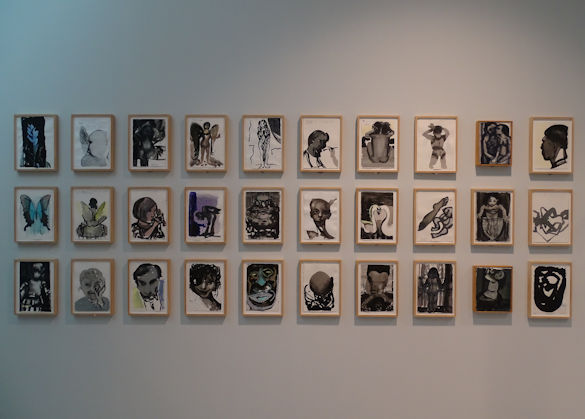


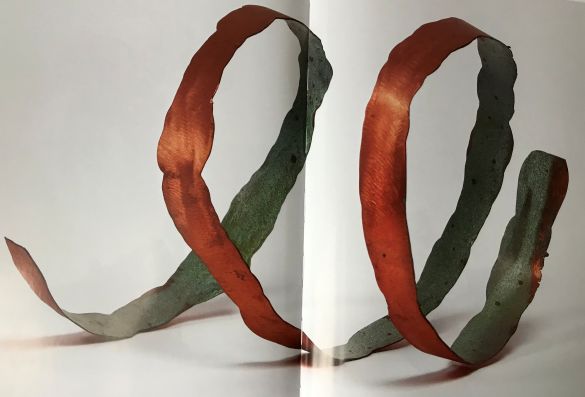


 Marlene Dumas, The Wall, 2009 zoals het schilderij afgebeeld staat over twee pagina’s in Metropolis M.


 Argusvlinder