Zenani Deorhi

Het is alleen al mooi dat je een bericht kunt maken
met een naam die de meeste mensen niets zal zeggen.
Maar als je een naam zoekt? Het is wel iets, toch?

Nog even verder wandelen in Jaipur, Amber Fort.

DSC_2659IndiaRajasthanJaipurAmberFortFortAjmer

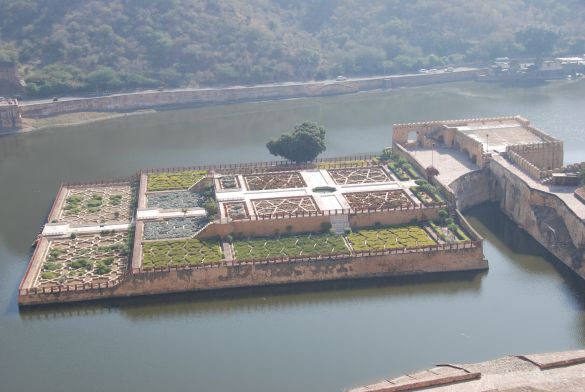
Zo, even de sfeer scheppen. Dit geeft een beetje een beeld van de omgeving.

DSC_2660IndiaRajasthanJaipurAmberFortFortAjmer


DSC_2661IndiaRajasthanJaipurAmberFortFortAjmerMetHickies

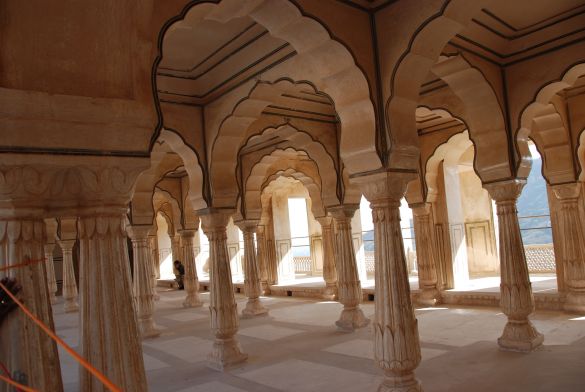
Mijn excuses. Het Baradari Pavilion op de achtergrond, achter mijn schoen met hickies, is een prachtig gebouw. Helemaal open, ergens midden in het paleis.


DSC_2662IndiaRajasthanJaipurAmberFortFortAjmer


DSC_2663IndiaRajasthanJaipurAmberFortFortAjmer


DSC_2664IndiaRajasthanJaipurAmberFortFortAjmerZenaniDeorhi


DSC_2665IndiaRajasthanJaipurAmberFortFortAjmerZenaniDeorhiTXT

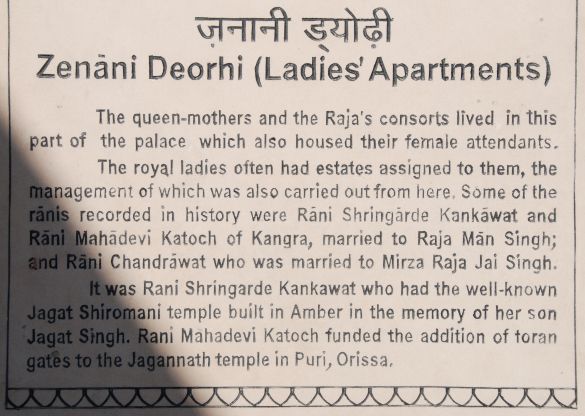
Zenani Deorhi of het verblijf van de koninklijke dames.


Zenani Deorhi (Ladies’ Apartments)

The queen-mothers and the Raja’s consorts lived in this part of the palace which also housed their female attendants.
The royal ladies often had estates assigned to them, the management of which was also carried out from here.
Some of the ranis recorded in history were Rani Shringarde Kankawat and Rani Mahadevi Katoch of Kangra, married to Raja Man Singh; and Rani Chandrawat who was married to Mirza Raja Jai Singh.
It was Rani Shringarde Kankawat who had the well-known Jagat Shiromani temple built in Amber in the memory of her son Jagat Singh.
Rani Mahadevi Katoch funded the addition of toran gates to the Jagannath temple in Puri, Orissa.
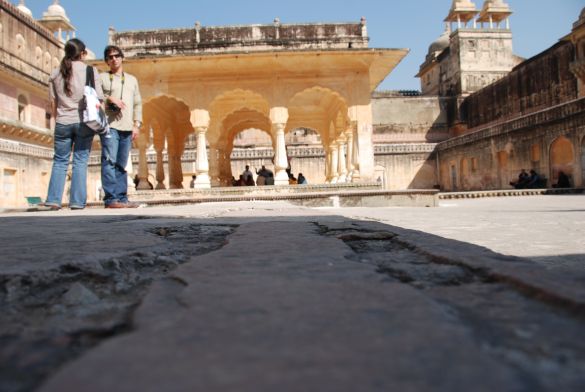
DSC_2666IndiaRajasthanJaipurAmberFortFortAjmer

Baradari Pavilion.


DSC_2667IndiaRajasthanJaipurAmberFortFortAjmerZenaniDeorhi


DSC_2668IndiaRajasthanJaipurAmberFortFortAjmer01

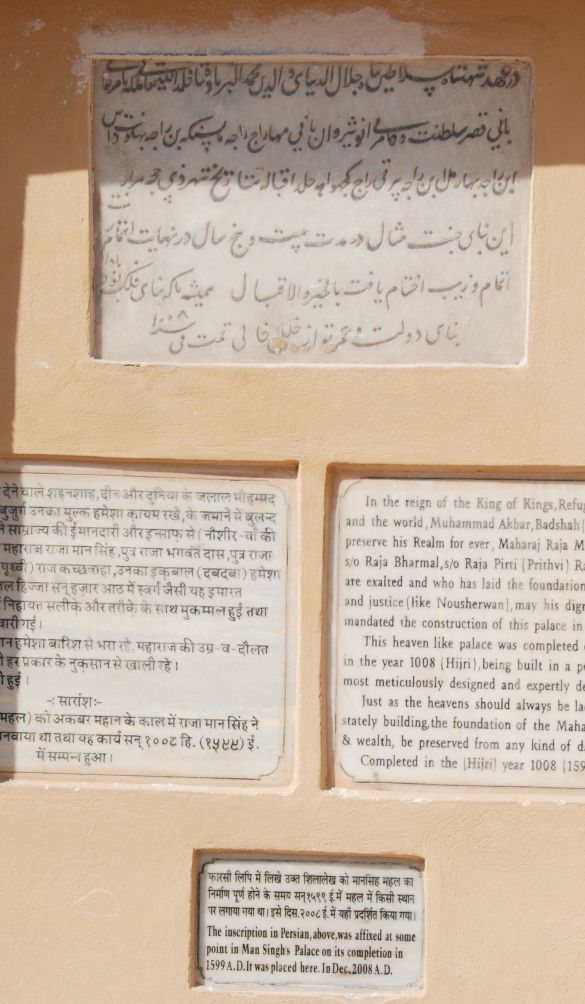
Het gaat mij niet zozeer om de inhoud van deze vier teksten (dat komt dadelijk) in drie talen (en schriften). Het gaat meer om de vormen van de tekens.

DSC_2668IndiaRajasthanJaipurAmberFortFortAjmer02

Het Engelstalige deel van de teksten:

In the reign of the King of Kings, Refuge of Sultans, glory of the faith and the world, Muhammad Akbar, Badshah (emperor), may the Almighty preserve his Realm for ever, Maharaj Raja Man Singh s/o Raja Bhagwant Das, s/o Raja Bharmal, s/o Raja Pirti (Prithvi) Raj Kachhwaha, whose commands are exalted and who has laid the foundation of his kingdom on uprightness and justice (like Nousherwan), may his dignity be maintained for ever, mandated the construction of this palace in his (Raja Man Singh’s) domain.
This heaven like palace was completed on the day of month Zil Hijja in the year 1008 (Hijri), being built in a period of 25 years, having been most meticulously designed and expertly decorated.
Just as the heavens should always be laden with rain, so also this stately building, the foundation of the Maharaj’s (Great King) longevity & wealth, be preserved from any kind of damage.
Completed in the (Hijri) year 1008 (1599 AD).

The inscription in Persian, above, was affixed at some point in Man Singh’s Palace on its completion in 1599 AD.
It was placed here in December 2008 AD.

DSC_2669IndiaRajasthanJaipurAmberFortFortAjmerGanesh

Met Ganesh, deze keer midden, boven de deur.
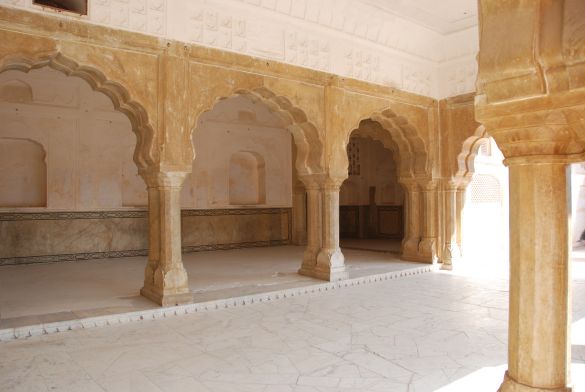

DSC_2670IndiaRajasthanJaipurAmberFortFortAjmer


DSC_2671IndiaRajasthanJaipurAmberFortFortAjmerWaaromSchoen

Sorry, weer die schoen.


DSC_2672IndiaRajasthanJaipurAmberFortFortAjmer

De vorige afbeelding (die met die schoen) is onderdeel van een brede strook onder aan een muur met meerdere afbeeldingen. Meest links is de afbeelding van Ganesh.
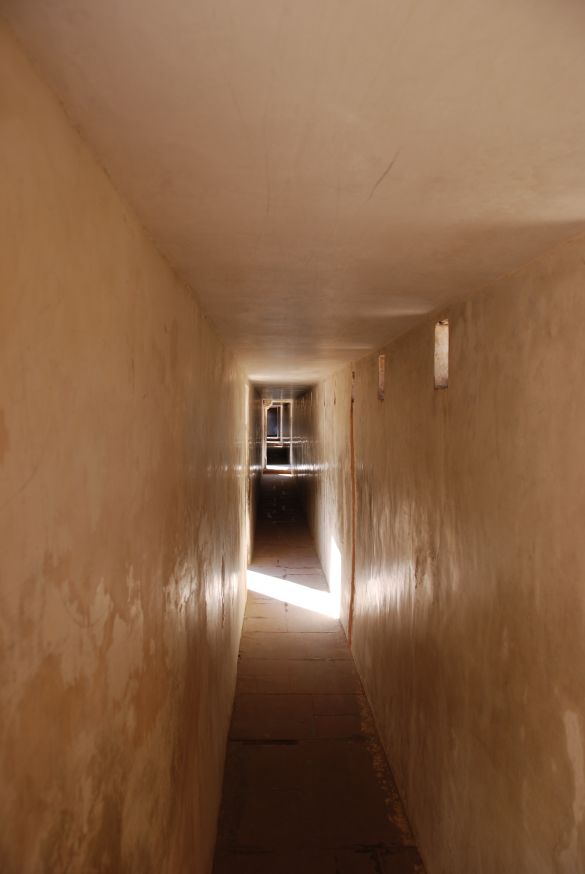

DSC_2673IndiaRajasthanJaipurAmberFortFortAjmer


DSC_2674IndiaRajasthanJaipurAmberFortFortAjmer


DSC_2675IndiaRajasthanJaipurAmberFortFortAjmer

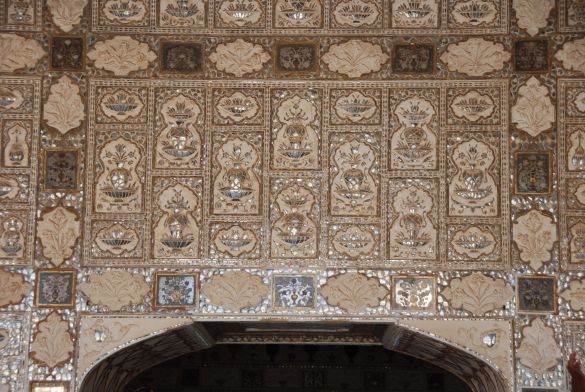
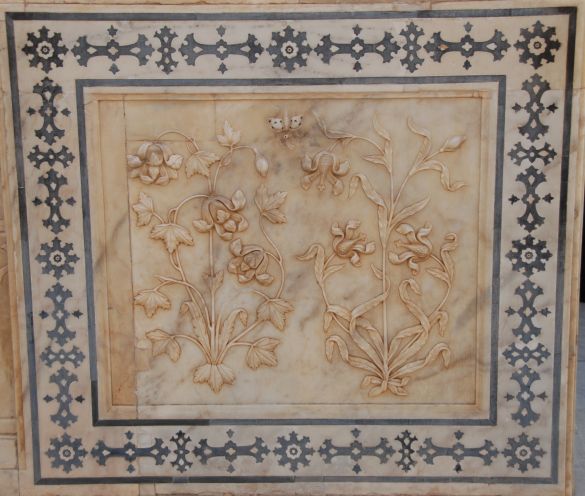
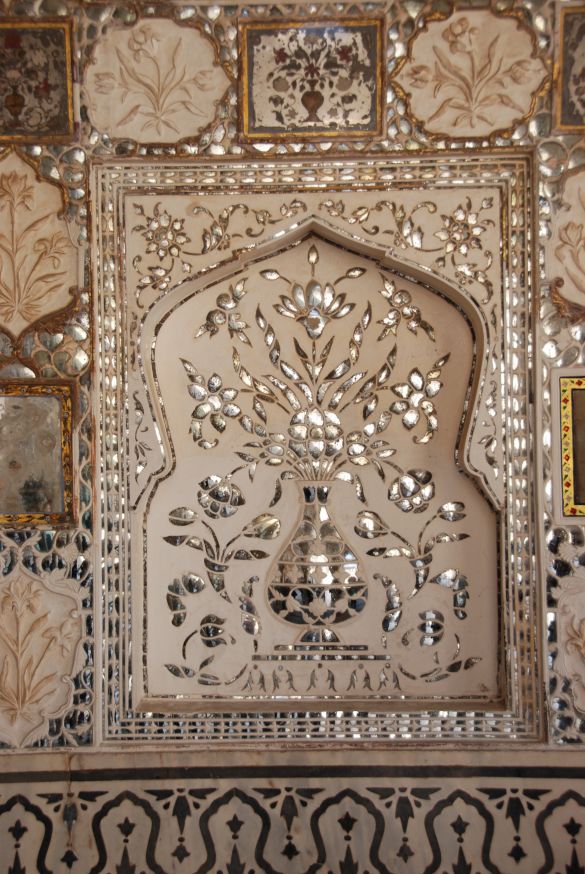
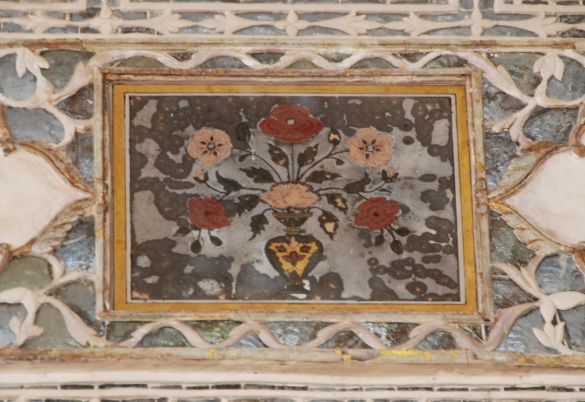
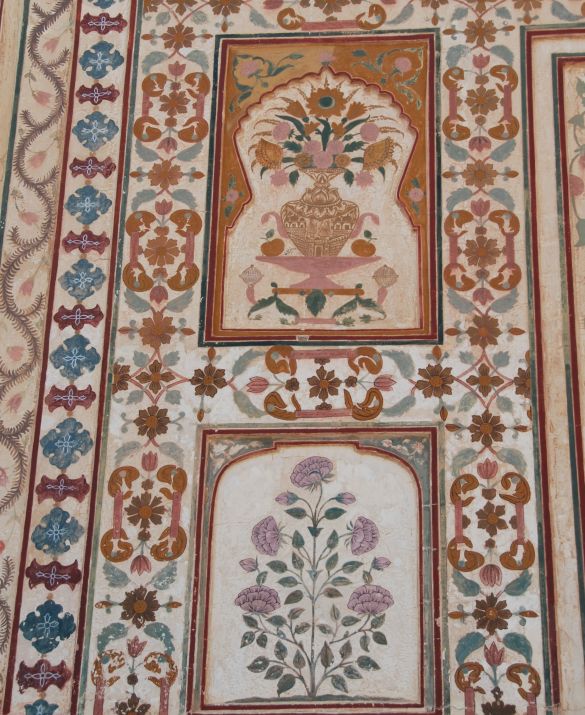
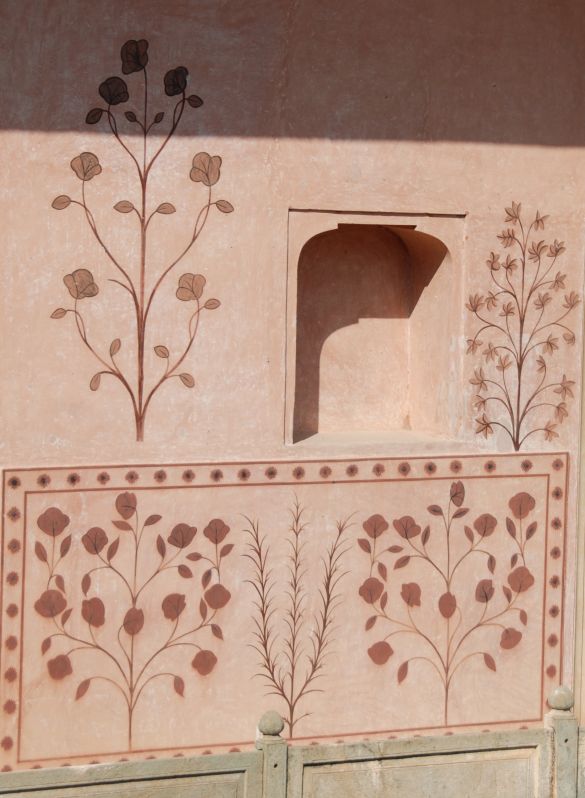
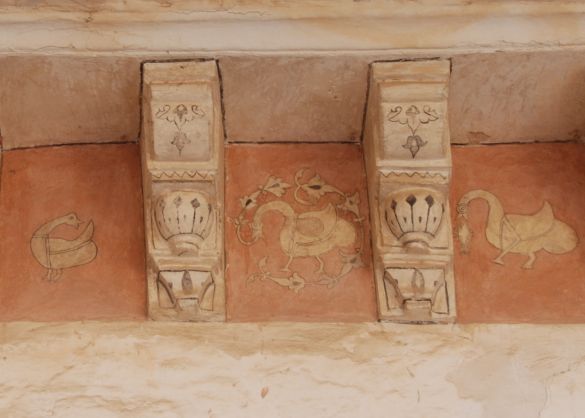
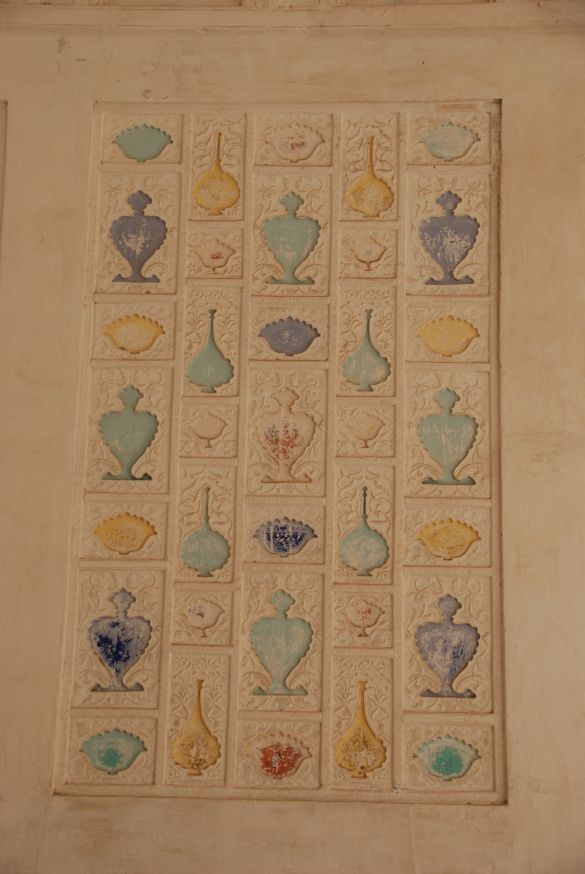
Geweldige decoraties!


DSC_2676IndiaRajasthanJaipurAmberFortFortAjmer


Meestal houd ik wel overzicht, ook in de foto’s.
Maar deze ruimtes hebben me helemaal in de details getrokken.
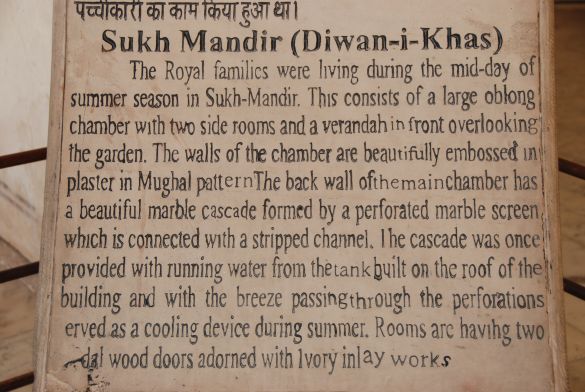
Sheesh Mahal of Glazen paleis

Na een aantal prachtige poorten, betreden we dan nu het privé
deel van het paleis in Fort Amber in Jaipur.

DSC_2629IndiaRajasthanJaipurAmberFortFortAjmerSukhMandirTXT

Sukh Mandir (Diwan-I-Khas)

The Royal Families were living during the mid-day of summer season in Sukh-Mandir.
This consists of a large oblong chamber with two side rooms and a verandah in front overlooking the garden.
The walls of the chamber are beautifully embossed in plaster in Mughal pattern.
The back wall of the main chamber has a beautiful marble cascade formed by a perforated marble screen which is connected with a stripped channel.
The cascade was once provided with running water from the tank built on the roof of the building and with the breeze passing through the perforations served as a cooling device during summer.
Rooms are having two sandal wood doors adorned with ivory inlay works.


DSC_2630IndiaRajasthanJaipurAmberFortFortAjmerSukhMandir

Versieringen in pleisterwerk.


DSC_2631IndiaRajasthanJaipurAmberFortFortAjmerSukhMandir


DSC_2633IndiaRajasthanJaipurAmberFortFortAjmerSukhMandir


DSC_2634IndiaRajasthanJaipurAmberFortFortAjmerSukhMandirTXT

Diwan-I-khas

On of the attractions of the Amber Palace is the Diwan-I-khas or the Hall of Private Audience.
Constructed during the period of Mirza Raja Jai Singh (1621 – 1667 AD), it was for this reason also called Jai Mandir and because of the beautiful mirror glass work in it, Sheesh Mahal or the Glass Palace.
The Raja met his special guests, like envoys from other rulers, here.
The upper part of the Diwan-I-Khas is known as Jas Mandir and is spell-binding in the intricate floral designs with glass in them.
The hamams or the baths are located north of the Jas Mandir.
The palace was kept cool in the summer by covering its arched openings with screens woven with the roots of the aromatic grass called Khas.
The screens were moistened periodically with water.
Air passing through the screens was thus cooled, and carried also the fragrance of the grass into the palace-chambers.
In front of the Sheesh Mahal is a parterred little garden in the classic Mughal pattern called Char-Bagh or four gardens.
Facing the Sheesh Mahal is Sukh-Niwas (Pleasure Palace), the Raja’s private apartments where he retired to rest.


DSC_2635IndiaRajasthanJaipurAmberFortFortAjmerSukhMandir


DSC_2636IndiaRajasthanJaipurAmberFortFortAjmerSukhMandir


DSC_2637IndiaRajasthanJaipurAmberFortFortAjmerSukhMandir


DSC_2638IndiaRajasthanJaipurAmberFortFortAjmerSukhMandir


DSC_2639IndiaRajasthanJaipurAmberFortFortAjmerSukhMandir


DSC_2641IndiaRajasthanJaipurAmberFortFortAjmerSukhMandir


DSC_2642IndiaRajasthanJaipurAmberFortFortAjmerSukhMandir

In dit privé-deel van het paleis was het erg druk. Dat staat haaks op hoe stil je wordt als je na al die jaren nog eens naar de foto’s kijkt om ze voor deze blog voor te bereiden.


Volgende keer het vervolg.
Ik liep eerst nog even een stukje terug.

Diwan-I-Aam en Ganesh Pol

Het fort staat bekend als Fort Amber of Ajmer Fort.
Het is een van de forten die op een heuvel staan en die
samen deel uitmaken van de World Heritage List van UNESCO.

DSC_2608IndiaRajasthanJaipurAmberFortSAmberFortEntrence

Dit is de toegang tot het paleis. Dit is een fort en paleis dat door veel toeristen bezocht wordt. Dat heeft denk ik vooral te maken met de toegankelijke ligging. Maar een paar kilometer buiten Jaipur, een grote stad in India met vliegveld.


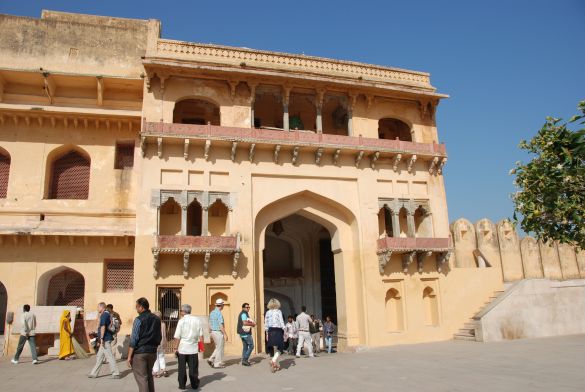
DSC_2609IndiaRajasthanJaipurAmberFortSinghPol

Snel volgt er nog een poort: Singh Pol of leeuwenpoort.


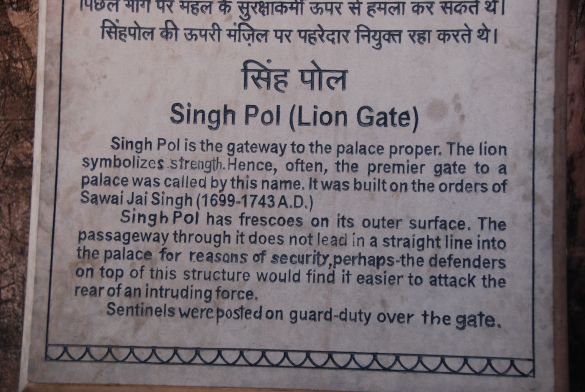
DSC_2610IndiaRajasthanJaipurAmberFortSinghPolTXT

Singh Pol (Lion Gate)

Singh Pol is the gateway to the palace proper.
The lion symbolizes strength.
Hence, often, the premier gate to a palace was called by this name.
It was built on the orders of Sawai Jai Singh (1599 – 1743 AD).
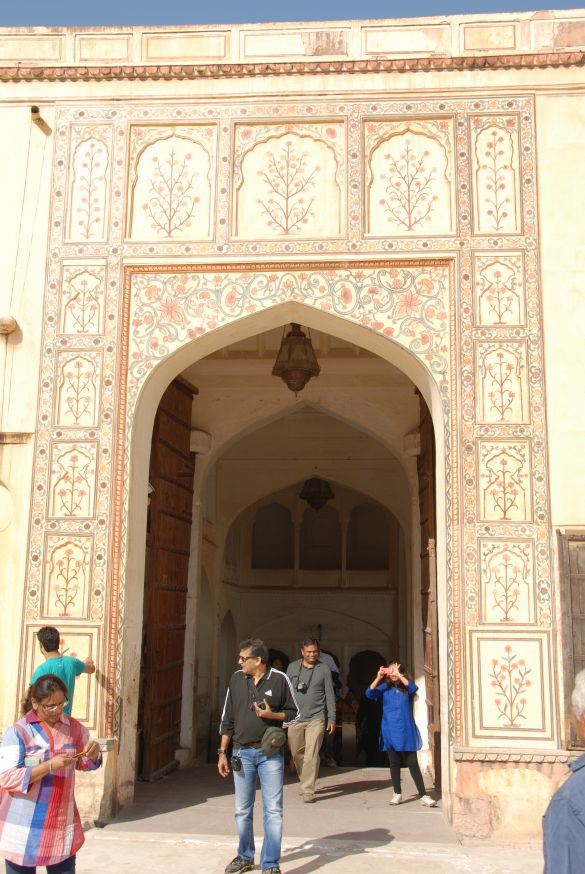
Singh Pol has frescoes on its outer surface.
The passageway through it does not lead in a straight line into the palace for reasons of security, perhaps the defenders on top of this structure would find it easier to attack the rear of an intruding force.
Sentinels were posted on guard-duty over the gate.

DSC_2611IndiaRajasthanJaipurAmberFortSinghPolDetail


DSC_2612IndiaRajasthanJaipurAmberFortSinghPolDetail


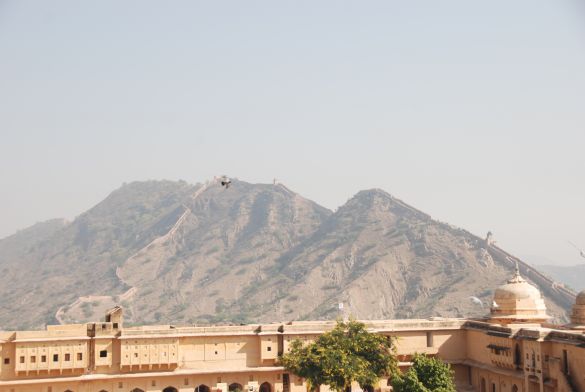
DSC_2613IndiaRajasthanJaipurAmberFortSinghPolZieMurenOpHeuvels

Over de heuvels in de omgeving lopen muren. De oppervlakte van het fort is dus groot. Het geeft de indruk dat er meerdere forten op de heuveltoppen liggen.


DSC_2614IndiaRajasthanJaipurAmberFortSinghPolAchterkant

Dit is de achterkant van Singh Pol.


DSC_2615IndiaRajasthanJaipurAmberFortDiwanIAam

Dit is de Diwan-I-Aam, de publieke audientieruimte.


DSC_2616IndiaRajasthanJaipurAmberFortDiwanIAam

Wederom zien we olifanten als kapiteel op de kolommen.


DSC_2617IndiaRajasthanJaipurAmberFortDiwanIAamTXT


Diwan-I-Aam (Hall of Public Audience)

Patterned after similar halls in Mughal palaces, the Diwan-I-Aam was the court where the Raja gave audiences to his subjects and met his officials.
Festivities on certain special occasions, like the celebrations following a victory in battle, Dussehra, the birthday of the Raja, were held here.
The building was constructed on the orders of Mirza Rajaman Singh (1589 – 1614 AD) in red sand stone and marble masonry.
Beautifully ornamented in carved patterns of elephant heads and vines, the details are charming confluence of the decorative features found in the Mughal and Rajput styles of architecture.
The distinctively constructed roof is supported by two rows of columns.
The outer ones, in coupled pairs, are of red sand stone and the inner ones of cream marble.

Maharaja Sawai Ram Singh II (1835 – 1880 AD) converted the rear portion of the hall into a billiard room.

South of Diwan-I-Aam are 27 “Kachehris” or offices (Toshakhana) running in a series.
These colonnaded arches housed the Government Secretariat from where the administration of Amber State was carried out.

DSC_2618IndiaRajasthanJaipurAmberFort


DSC_2619IndiaRajasthanJaipurAmberFortGaneshPol

De volgende poort is de Ganesh Pol.


DSC_2620IndiaRajasthanJaipurAmberFort


DSC_2621IndiaRajasthanJaipurAmberFort


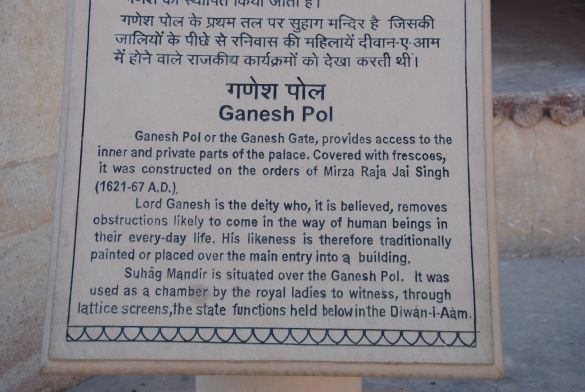
DSC_2622IndiaRajasthanJaipurAmberFortGaneshPolTXT


Ganesh Pol

Ganesh Pol or the Ganesh Gate, provides access to the inner ans private parts of the palace.
Covered with frescoes, it was constructed on the orders of Mirza Raja Jai Singh (1621 – 1667 AD).

Lord Ganesh is the deity who, it is believed, removes obstructions likely to come in the way of huming beings in their every-day life.
His likeness is therefore traditionally painted or placed over the main entry into a building.

Suhag Mandir is situated over the Ganesh Pol.
It was used as a chamber by the royal ladies to witness, through lattice screens, the state functions held below in the Diwan-I-Aam.

DSC_2623IndiaRajasthanJaipurAmberFortGaneshPol

Zo ga je de poort binnen.


DSC_2624IndiaRajasthanJaipurAmberFortGaneshPol

We zijn nog niet eens echt binnen en je wordt overweldigd door de pracht en praal.


DSC_2625IndiaRajasthanJaipurAmberFortGaneshPol

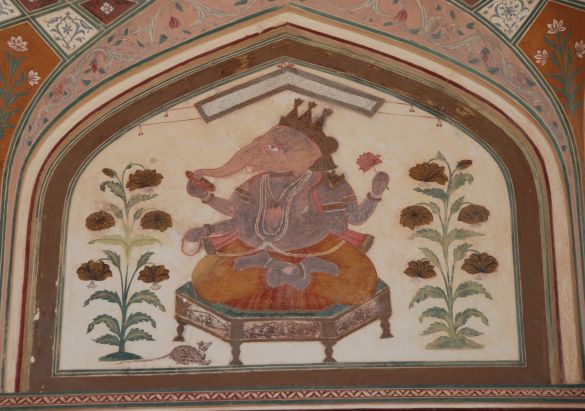
Dit is de centrale afbeelding van Ganesh op de poort.


DSC_2626IndiaRajasthanJaipurAmberFortGaneshPol


DSC_2627IndiaRajasthanJaipurAmberFortGaneshPol


DSC_2626IndiaRajasthanJaipurAmberFortGaneshPol

In het volgende bericht over deze reis naar India
gaan we de privé-vertrekken bekijken.