India 24/25: Delhi, dag 5 – National Museum V

Groter dan het huidige India, lange geschiedenis over vele rijken

Het blogbericht wat je nu leest, vervolgt de wandeling door het
National Museum in New Delhi.
Er is zoveel te zien, de voorwerpen bestrijken een enorme geschiedenis,
in tijd, in geografie, in religie en bestuursvormen.
Één ding hebben veel voorwerpen gemeen:
ze kunnen heel mooi zijn.
Geniet met mij mee.

DSC01218IndiaNewDelhiNationalMuseumMoustachedMaleHeadEvidentMauryanPolishAndAbsenceOfJewellerySarnathChunarSandstone3rd-2ndCentBC

India, New Delhi, National Museum, Moustached male head, evident(ly) Mauryan polish and absence of jewellery, Sarnath, chunar sandstone, 3rd – 2nd century BC.


DSC01217IndiaNewDelhiNationalMuseumTheMauryanDynasty4th-3rdCenturyBCETxtDSC01214IndiaNewDelhiNationalMuseumRiderOnAnElephantMathuaUttarPradeshTerracottaAccNo83125

Rider on an elephant, Mathura, Uttar Pradesh, terracotta.

DSC01215 01 IndiaNewDelhiNationalMuseumRiderOnAnElephantMathuaUttarPradeshTerracottaAccNo83125DSC01215 02 IndiaNewDelhiNationalMuseumRiderOnAnElephantMathuaUttarPradeshTerracottaAccNo83125 Detail

Het oog van de olifant is zo leuk.


DSC01220 01 IndiaNewDelhiNationalMuseumElephantsCarryingBudhasRelicsCopingStoneFromBhahutStupaRailingShunga2ndCentBCEMadhyaPradeshCarvedSandstoneAccNo68 168

Elephants carrying Buddha’s relics, coping stone from Bharhut stupa railing, Shunga, 2nd century BCE, Madhya Pradesh, carved sandstone.

DSC01220 02 IndiaNewDelhiNationalMuseumElephantsCarryingBudhasRelicsCopingStoneFromBhahutStupaRailingShunga2ndCentBCEMadhyaPradeshCarvedSandstoneAccNo68 168


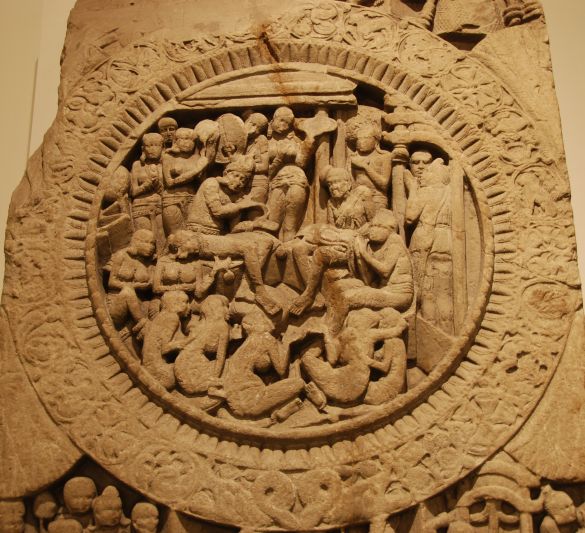
DSC01222 01 IndiaNewDelhiNationalMuseumAmaravathiStupasIllustrationCasingSlabSatavahana1st-2ndCentCEAndhraPradeshCarvedLimestoneAccNO70L2

Amaravathi stupa’s illustration, casing slab, Satavahana, 1st – 2nd century CE, Andhra Pradesh, carved limestone.

DSC01222 02 IndiaNewDelhiNationalMuseumAmaravathiStupasIllustrationCasingSlabSatavahana1st-2ndCentCEAndhraPradeshCarvedLimestoneAccNO70L2 OpbouwTonenRechts

De gelaagde structuur is heel mooi. Daarom hierboven een detail van het centrale deel van de voorstelling, in de hoop dat zo de opbouw beter te zien is.


DSC01224IndiaNewDelhiNationalMuseumYakshaSunga2ndCentBCAminHaryanaStoneAccNoM16-1

Yaksha, Shunga, 2nd century BC, Amin, Haryana, stone.

DSC01225IndiaNewDelhiNationalMuseumYakshaSunga2ndCentBCAminHaryanaStoneAccNoM16-1DSC01226IndiaNewDelhiNationalMuseumYakshaSunga2ndCentBCAminHaryanaStoneAccNoM16-1


DSC01228 01 IndiaNewDelhiNationalMuseumAmorousCoupleSunga2ndCentBCAminHaryanaStoneAccNoM16-2 121cmH43W33-5D

Amorous couple, Shunga, 2nd century BC, Amin, Haryana, stone. Om een idee te geven dit voorwerp is 121 cm hoog, 43 cm breed en 33,5 diep.

DSC01228 02 IndiaNewDelhiNationalMuseumAmorousCoupleSunga2ndCentBCAminHaryanaStoneAccNoM16-2 121cmH43W33-5D Detail


DSC01230IndiaNewDelhiNationalMuseumBuddhaHeadGandhara2nd-3rdCentADAccNo62 233

Buddha head, Gandhara, 2nd – 3rd century AD.


DSC01233IndiaNewDelhiNationalMuseumHeadOfAYouthGandhara2nd-3rdCentAD49 20157

Head of a youth, Gandhara, 2nd – 3rd century AD.


DSC01235 01 IndiaNewDelhiNationalMuseumBuddhaWithNaga-KaliaGandhare2ndCentADStoneAccNo69 140

Buddha with Naga-Kalia, Gandhare, 2nd century AD, stone.

Voorstellingen als deze vind ik persoonlijk erg mooi maar
zijn ook druk. Er gebeurt veel, al is de voorstelling
niet naturalistisch. Het is geen foto.
Het is een gecomponeerd beeld.
Een beetje zoals de middeleeuwse schilderijen dat kunnen zijn.
Maar dan vanuit een andere tijd en cultuur.

In het midden, de grootste figuur, dat is natuurlijk Boeddha.
Naast zijn plaats in de voorstelling en zijn grootte maakt
de aureool meteen duidelijk dat dit
de belangrijkste persoon is.
Er is nog een kleinere persoon met een aureool.
Die staat helemaal links, het hoofd ontbreekt helaas.

Het kleed van Boeddha is ook anders dan bij de andere personen
in het tafereel. Die hebben korte mouwen en wanneer hun kleding
het hele lichaam bedekt,
lijkt er een koord om hun middel te zijn aangebracht.

Boeddha kijkt naar rechts.
Zijn houding suggereert dat hij spreekt en
dat de mensen rechts van hem naar hem luisteren.
Tegelijkertijd lijkt hij iets te schenken:
in zijn linkerhand houdt hij een ovaal voorwerp.

Rechts, onder een boom, zijn drie personen te zien.
Mogelijk is dit de bodhi-boom,
symbool van verlichting in het boeddhisme.
De drie karakters kijken op naar Boeddha en lijken hun
handen gevouwen te hebben.
De drie personen lijken achter een railing te staan die hun wereld
apart zet van de wereld waar Boeddha zich in beweegt.
Het zijn de kleinste personen in de voorstelling. Dan heb ik
het niet per se over hun fysieke grootte
maar ze zijn de minst belangrijke personen in de voorstelling.

Rechts van de personen zien we een slang, die, als we de
richting van zijn kop volgen, naar de boom lijkt te kijken
of er misschien naar toe gaat.

Volgens de zaaltekst gaat het hier om Naga-Kalia.
Hier wordt niet het dier ‘slang’ bedoeld maar
een bovennatuurlijk wezen dat vaak de Boeddha erkent en beschermt.

De personen achter Boeddha, dus links van hem, zijn
waarschijnlijk volgelingen of koninklijke figuren.
Één van hen draagt iets in zijn hand die hij schuin naast
zijn hoofd houdt.
Is dat een manier van dragen of dreigt hij te gooien?

Al deze figuren staan onder een dak en naast een pilaar
die je aan de rechterkant ziet.
Het lijkt wel een Grieks-Romeinse tempel en dat sluit
aan bij de invloed van Alexander de Grote die met zijn
soldaten die cultuur bracht in het gebied dat ligt
in wat we vandaag Pakistan/Afghanistan noemen: Gandhara.

De kunst van Gandhara was in de tweede eeuw na Christus
op zijn hoogtepunt.
Deze stele uit Gandhāra laat zien hoe kunst
niet alleen een spiegel van de werkelijkheid is,
maar vooral een drager van
geloof, symboliek en culturele vermenging.

DSC01236IndiaNewDelhiNationalMuseumBuddhaWithNaga-KaliaGandhare2ndCentADStoneAccNo69 140TxtDSC01235 02 IndiaNewDelhiNationalMuseumBuddhaWithNaga-KaliaGandhare2ndCentADStoneAccNo69 140 Detail


DSC01237IndiaNewDelhiNationalMuseumJainVotivePlaqueAyagapattaKushana2ndCentADKankaliTilaMathuraUttarPradeshMottledRedSandstoneAccNoJ249

Jain votive plaque (Ayagapatta), Kushana, 2nd centiry AD, Kankali Tila, Mathura, Uttar Pradesh, mottled red sandstone.


Bij een groot aantal van de voorwerpen is een heel verhaal
te vertellen. Bij een voorwerp heb ik dat geprobeerd.
Geniet!

Harappa – Maurya Dynasty

Terug in het National Museum in New Delhi
vervolgen we onze weg door de fantastische collectie.

DSC_2772NewDelhiNationalMuseumHarappa


DSC_2773NewDelhiNationalMuseumHarappa


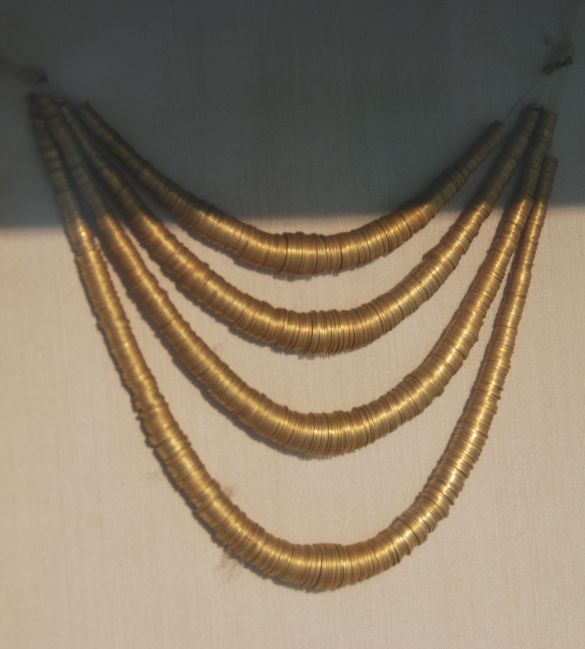
DSC_2774NewDelhiNationalMuseumHarappaMandiJewlleryHoard

Er is een schat te zien. Juwelen uit een plaats met de naam Mandi. Het is de moeite waard om het verhaal op Wikipedia er eens op na te slaan.


DSC_2775NewDelhiNationalMuseumHarappaMandiJewlleryHoard

De vitrine met een groot aantal voorwerpen.


DSC_2776NewDelhiNationalMuseumHarappaMandiJewlleryHoard

DSC_2778NewDelhiNationalMuseumHarappaMandiJewlleryHoardTXT

Jewellery Hoard from Mandi

The chance discovery of gold jewellery from the ancient site of Mandi, district Muzzaffarnagar (western Uttar Pradesh),
in association with other materials of the Harappan genre, shot the site into prominence on the Harappan archaeological map of India.
The discovery was in form of a large treasure of gold and silver ornaments besides ornaments od semi-precious stones.
Thew villagers found the treasure in course or agricultural operations.
Yhe gold jewellery, kept in the copper containers, consisted of big and small “heart shaped” Kara-S (bangles), spacers, terminals, conical beads, etc.
This jewellery collection is comparable to those of Mohenjodaro, Quetta and Allahadino.
The treasure of the gold jewellery recovered from Mandi is the largest so far found in the Bronze Age Harappan civilization of South Asia.

DSC_2780NewDelhiNationalMuseumHarappaMandiJewlleryHoard


DSC_2781NewDelhiNationalMuseumMauryaDynasty

Een flinke stap in de tijd. De Harappan-periode laten we achter ons. We stappen in de tijd van de Maurya Dynasty. Dit beeld van een man met een snor is een voorbeeld van het beeldhouwwerk uit deze tijd.


DSC_2782NewDelhiNationalMuseumMauryaDynasty

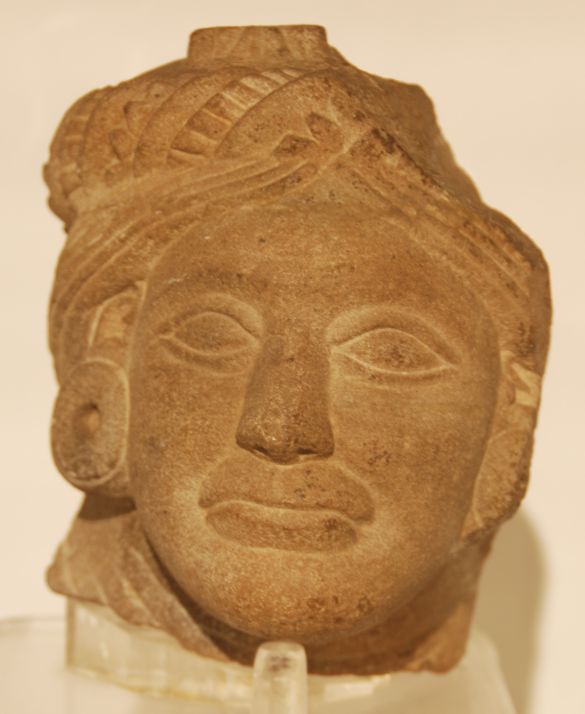
Ook deze kop van een man met tulband is uit die tijd.


Er viel een hele tekst over dit tijdperk te lezen:

Maurya Dynasty
4th – 3rd century BC

The decline of the urban Harappan culture in 2000 BC was succeeded essentially by rural cultures which were followed by another phase of urbanization.
4th Century BC witnessed the rise of Magadha Empire (present day Bihar) under the rule of Chandragupta Maurya in 323 BV.
The empire later expanded and for the first time was politically unified under Ashoka (circa BC 272 – 231), the most illustrious of the Mauryan Kings.
During his rule the Mauryan Empire extended from Afghanistan in the Northwest, to Orissa and Nepal in the east and Andgra Pradesh and Karnataka in the south.

The first organized art activity in India on a bigger scale and durable material like stone belong to this period.
The Mauryan sculptures and art motifs have two distinct sources of inspiration: indigeous and West Asian.
The influence of Perso-Hellenistic art can be traced back to the time of Chandragupta Maurya, who, it seems, patronized the craftsmen from Achaemenid empire (present day Persia).
The famous stone peristylar assembly hall (commonly called the “Chandragupta Sabha”) following a Persopolitan model built by him at Kumrahar near Patna, is especially noteworthy.
Fall of Achaemenid Empire, resulting from the campaign led by Alexander the Great, caused an influx of unemployed craftsmen to the Mauryan court, thus instituting dramatic changes in both technique of sculpting and art styles, essentially in the development of stone working methods.
The important art centers of the Mauryan Empire were Pataliputra, Buxor, Mathura, Kaushambi.

Stone came to ve associated permanently with Indian art from the times of Ashoka.
The cultural interaction with West Asian countries may have inspired him to go for monumental art and architecture in stone.
During this period different manifestations of art such as Rock cut caves, Monolithic pillars, Ring stones, Disc stones and Terracotta objects were popular.
Representations of these manifestations van be viewed in the translite.

Rock cut caves
The magnificent rock cut caves of Barabar and Nagarjuni hills near Gaya in Bihar are vivid examples of the monumental work undertaken during this erz.

Monolithic pillars
Ashoka’s reign was marked by meticulously carved monolithic pillars with magnificent animal capitals and inscribed edicts, of which the lion capital of Sarnath, adopted as the National emblem of India (displayed at Archaeological Museum at Sarnath near Varanasi) and the bull capital from Rampurva (now displayed in the Rashtrapathi Bhawan) are well -known.
Stome art of this period was characterized by a high polish achieved by probably rubbing the surface with fine grained sand and buffing it with cloth of animal skin.

Stone sculptures
The stone sculptures of the Mauryan period are also reminiscent of the high polish, such as the famous Yakshi or female figure with flywhisk, in chunar sandstone found in Didarganj (in Patna) now in Patna Museum.
Displayed in this gallery are few significant fragments of stone sculptures displaying high technical skills, discovered in Sarnath.
The West Asian influence is notable in the two male heads displayed, characterized by a mustache and turban respectively.

Ringstones and discstones
Ringstones and discstones, though small, depict some of the finest carvings in earlt lithic art and can be regarded as cult objects.
The discstones appear to be related to ring stones in evolution, iconography, size and general shape but have no central void and usually undecorated.
They represent an extraordinary miniature world in itself with intricately carved mythical and ritualistic motifs.

Terracotta objects
Terracotta figures moulded in lively poses form an important group of art objects during the Mauryan period.
Due to the agrarian nature of the Indian society, earth was symbolised in the popular cult of Mother Goddess (the source and sustainer of life) which appear to be the popular cult of the period.
One of the most outstanding examples from Mathura, on display, is a seated Mother Goddess with a child on her lap.
Moulding techniques were used for the face, whereas the body was hand modeled and the elaborated headdress, decorated with rosette disc, ornaments like sarpa-kundalas (coiled rings) were applied, hence the technique is referred as “appliqué”.

The dawn of monumental and imperialistic sculptural art and architecture, patronized by the state for the first time, was the noteworthy contribution of the Mauryas.

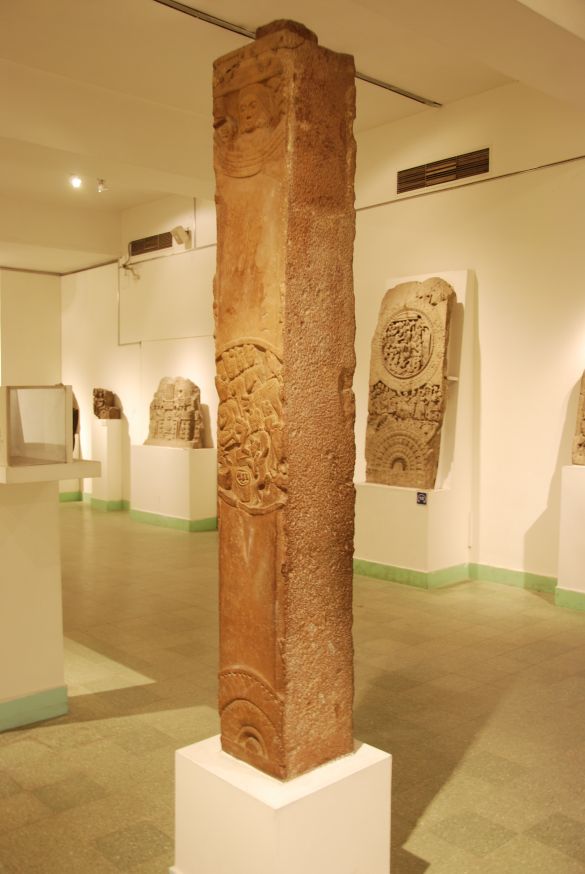
DSC_2784NewDelhiNationalMuseumPillarShowingJatakaStoriesSunga2ndCentBCAccNo68161

Pillar showing Jataka stories, Sunga 2nd century BC. Bharhut, Madhya Pradesh.


DSC_2785NewDelhiNationalMuseumPillarShowingJatakaStoriesSunga2ndCentBCAccNo68161


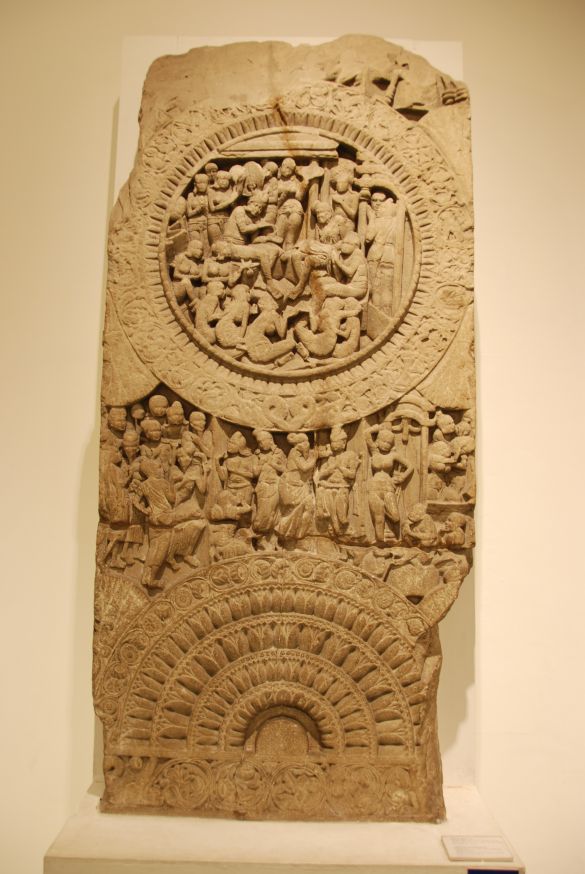
DSC_2787 NewDelhiNationalMuseumAsitasVisitToSuddhadhanaSatavahana1st2ndCentADAmaravatiAndhraPradeshAccNo70L4

Asitas visit to Suddhadhana, Satavahana, 1st – 2nd century AD, Amaravati, Andhra Pradesh.


DSC_2788NewDelhiNationalMuseumAsitasVisitToSuddhadhanaSatavahana1st2ndCentADAmaravatiAndhraPradeshAccNo70L4


DSC_2790NewDelhiNationalMuseumKingOnAnElephantRailingCrossBarSunga2ndCentBCMathuraUttarPradeshAccNo50167

King on an elephant (Railing cross-bar), Sunga, 2nd century BC, Mathura, Uttar Pradesh.


Als een sprookje: slapende Boeddha

Deel 34 van mijn reisverslag van onze reis van Hyderabad naar Mumbai.

 photo 20121220GoumlranSoumlderstroumlmShabashProLight.jpg


Ik kan me zo voorstellen dat lezers die regelmatig terugkeren
op de Argusvlinder, het idee hebben: alweer een blog over Ajanta.
Inderdaad, vandaag de laatste. Maar wat voor een.
De slapende Boeddha ligt niet te slapen.
het enorme beeld stelt de zojuist overleden Boeddha voor.
Hij ligt op een bed omringd door zijn vrienden en bekenden die
over hem rouwen en hemelse figuren.
Het is een van de vele tijke versieringen van cave 26.
Kijk maar eens mee:

 photo DSC_0750GevelVanChaityaGrihaCave26MetRijkeVersiering.jpg

Dit is de gevel van de Chaitya-Griha, dit is een speciaal type grot. De versiering is heel uitbundig.


 photo DSC_0750GevelVanChaityaGrihaCave26MetRijkeVersieringDetail.jpg

Hier zie je een deel van die gevel.


 photo DSC_0751.jpg

Hoofd van een van de Boeddha-beelden in de gevel.


 photo DSC_0752.jpg


 photo DSC_0754InDeGevel.jpg

Dat de beelden niet altijd even natuurgetrouw zijn laat dit voorbeeld zien.


 photo DSC_0756DeceasedBuddhaMahaparinitvana.jpg

Hier is hij dan. Het enorme beeld van de overleden Boeddha. Als een prins die ligt te slapen. Er is een speciale naam voor deze voorstelling: Mahaparinitvana.

De gids die ik in Ajanta kocht zegt over dit beeld het volgende:

The usual cliche of figures of Buddha on the walls of the aisles is however, relieved by two scenes, one representing the mahaparinirvana of Buddha and the other, the Assault and Temptation of Mara.
The former, carved on the left wall near the side-door, contains a colossal figure of Buddha reclining on his right side on a couch between two sala trees; below are the figures of his disciples and followers mourning his decease, and above are celestial beings.


 photo DSC_0757Cave26ChaityaGriha.jpg

Zicht op het interieur van cave 26.


 photo DSC_0760ZijkantVanDeStupa.jpg

De stupa is heel uitgebreid gedecoreerd zoals hier te zien aan de zijkant.


 photo DSC_0760ZijkantVanDeStupaDetail.jpg

Detail.


 photo DSC_0761ZeerRijkeDecoratie.jpg


 photo DSC_0762TemptationOfMara.jpg

Dit is de tweede belangrijke beeldengroep in deze Chaitya-Griha: Assault and Temptation of Mara. Op het web heb ik maar een redelijke foto van deze beeldengroep kunnen vinden en die toont Mara niet eens. Die zit namelijk (onder andere) op een olifant, links boven de Boeddha.

De gids schrijft hierover:

The second scene also occurs on the same wall. Here Buddha is seated, with his right palm in the bhumisparsas mudra under the Bodhi tree at the centre; on the left is Mara on an elephant accompanied by his host of demon-forces attacking Buddha; on the right is the retreat of Mara; in the foreground are the daughters of Mara trying to tempt Buddha by dance and music; and in the bottom right corner is the figure of the dejected Mara.


 photo DSC_0765InterieurChaityaGriha01.jpg

Nogmaals het interieur.


 photo DSC_0765InterieurChaityaGriha02DeStupaHeelRijkGedecoreerd.jpg

De volgorde van de foto’s is een beetje verwarrend maar dat is veroorzaakt doordat ik slecht voorbereid was op deze grot die drie ingangen bleek te hebben en de drukte in deze zeer tot de verbeelding sprekende Chaitya-Griha. In de oude grotten is de stupa niet of nauwelijks gedecoreerd. Deze veel jongere grot laat de ontwikkeling in het Boeddhisme en en de kunst goed zien.


 photo DSC_0769.jpg


 photo DSC_0770DeLaatsteBlik.jpg

Een laatste blik op de site.


 photo DSC_0771CadeauBoekOverAjantaEnEenOverElloraKeurigIngepakt.jpg

Ik kocht er twee gidsen. Een gids over Ellora en een over Ajanta. Ze werden keurig ingepakt. Thuis heb ik ze uitgepakt en dan zien ze er als volgt uit:

 photo DSC_0771CadeauBoekOverAjantaEnEenOverElloraKeurigIngepaktEnDanThuis.jpg


 photo DSC_0772EenVanDeVeleVogelsOpDeSite.jpg

In de afdaling naar de uitgang had ik nog even tijd om een van de vele vogels die er leven te fotograferen.


 photo DSC_0773AjantaCaves.jpg

Ajanta Caves

Ajanta Caves are famous for their murals which are the finest surviving examples of Indian Art, particularly painting. These caves were excavated in horse-shoe shaped bend of rock scarp nearly 76 mtr in height overlooking a narrow stream known as Waghora.
The location of this valley provided a calm and serene environment for the Buddhist monks who retreated at these secluded places during the rainy season. Each case was connected to the stream by a flight of steps, which are now almost obliterated, albeit traces of some could be noticed at some places. In all 30 caves were hewn out of the living rock in different periods according to the necessity.
Out of these, five (cave 9, 10, 19, 26 and 29) are Chaityagrihas and the rest are vihares. In date and style also these caves can be divided into two broad groups. Out of the 30 caves 6 caves belong to the earliest phase of Buddhism ie Hinayana. Caves 9 & 10 which are Chaityagrihas and 8, 12, 13 and 15A which are Viharas belong to this phase. These caves are datable to the pre-Christian era, the earliest among them being cave 10 dating from the second century BC where the object of worship is a stupa. These caves are imitation of contemporary wooden constructions even to the extent of fixing of wooden rafters and beams to the ceiling even though they are non-functional.
These early caves were painted but nothing substantial has survived. Caves No 9 and 10 clearly show some vestiges of painting. The headgear, ornaments of the images in these paintings resemble the bas-relief sculpture of Sanchi and Bharhut.
The addition of new caves could be noticed again during the period of Vakatakas, the contemporaries of the imperial Guptas. These were caused to be excavated by the royal family and also the feudatories owing allegiance to the Vakatakas. Varahadeva, the minister of Vakataka king Harishena (475-500 AD) dedicated Cave 16 to the Buddhist Sangha while cave 17 was the gift of a prince (who subjugated Asmaka) a feudatory of the same king. A flurry of activity at Ajanta was between mid 5th century AD to mid 6th century AD. Hieun Tsang, the famous Chinese traveller who visited India during the first half of the 7th century AD has left a vivid and graphic description of the flourishing Buddhist establishments here even though he did not visit the caves.
A solitary Tashtrakuta inscription in cave no 26 indicates its use during 8th – 9th centuries AD. The second phase departs from the earlier one with the introduction of new pattern in layout as well a the centrality Buddha image, both in sculpture as well as in paintings.
All these caves which were once painted but now the best examples of these exemplary paintings of Vakataka period could be noticed only in caves 1, 2, 16 and 17. The variation in style and execution in these paintings also are noticed, mainly due to different authors who followed contemporary style.
the main theme of the paintings is the depiction of various Jataka stories-different incidents associated with the life of Buddha, and the contemporary events and social life. The ceiling decoration invariably consists of decorative patterns, geometrical as well as floral. Apart from painted representations, sculptural panels also adorn the beauty of the caves.
Ajanta paintings are the best examples of Tempra technique, executed after elaborate preparation of rock surface. After chiselling rock surface, different layers of clay mixed ferruginous earth, sand, fibrous material of organic origin were applied very carefully. Then the surface was finally finished with a thin coat of lime wash.
Over this surface, outlines are drawn boldly, then the spaces are filled with requisite colours in different shades and tones to achieve the three dimensional effect of rounded and plastic volumes. The colours and shades utilised also vary from red and yellow ochre, terra verte, to lime, kaolin, gypsum, lamp black and lapis lazuli. The chief binding material used here was glue.
The group of caves is inscribed by the UNESCO as a World Heritage Monument in the year 1983.


Het lettertype in de titel van 20 december 2012 is van Göran Söderström/Goran Soderstrom en heet Shabash Pro Light.