Shanghai – Nanjing 2016

Enkele jaren geleden bezocht in Beijing.
Ten noorden van Beijing bevinden zich de Ming-graven.
In een prachtig gelegen valei tussen de heuveld liggen de
graven en de monumenten die bij die graven liggen met
een Sacred Way (heilig pad) er naar toe.

Maar de oudste Ming tomb ligt bij Nanjing, de eerste
hoofdstad van China.
Die bezocht ik afgelopen september.
Vanaf het metrostation loop je naar een soort cultuur park
met als een van de complexen dit graf.
Je komt bij het graf over een pad met beelden.

 photo DSC_0719.jpg

Een minister.


 photo DSC_0720WengzhongPath.jpg

Wengzhong Path

Wengzhong Path, 250 meters long, constitutes the second section of the Sacred Way.
This section is flanked by a pair of balusters, two pairs of generals and two pairs of civil officials.
The balusters, with a cylinder crown at the top as well as cloud and dragon designs over the column, have changed the convention of topping the balusters along the Sacred Way with lotus-flower design since the Tang and Sond Dynasties.
It is of innovative significance in art.
The statues of the genrals and officials stand there with great dignity, guarding the tomb with their loyalty.


 photo DSC_0721WorldHeritageMonumentXiaolingTombOfTheMingDynasty.jpg

Het gebied is een World Heritage Monument. De naam is de Xiaoling Tomb of the Ming Dynasty.

Xiaoling Tomb Of The Ming Dynasty
Xiaoling (Filiai Tomb) is the burial place
of Zhu Yuanzhang, founding emperor of the
Ming Dynasty (1368-1644) The architectural
system, inheriting from its predecessors while
creating a new standard of its own, was
followed by all the other imperial tombs of the
Ming and Qing Dynasties (1368 – 1911) for more
than 500 years, and thus accupied a milestone
position in the history of the system of ancient
Chinese imperial tombs.


 photo DSC_0723.jpg

De ligging is prachtig en het weer was goed.


 photo DSC_0725EenHeelComplex.jpg

Het is een heel complex met allerlei attracties. Heerlijk om er te wandelen.


 photo DSC_0726.jpg

De toegangspoort tot het eigenlijke complex.


 photo DSC_0727AltijdEenSchildpad.jpg

In het stele-gebouw (Wen Wu Fang Men (The Gate of the Civil and the Military)) zie je altijd een schildpad (eeuwigheid) met op de rug inscripties over de keizer. In dit geval ook van een latere keizer.


 photo DSC_0728Wierrookbranders.jpg

Huisje om beschreven documenten te verbranden.

Placed before the Sacrificial Hall on each side of it’s gate, the pair of Sacrificial Censers are actually two small temple-shaped buildings made of yellow and green glazed materials.
The censers are covered with single – eave gable-and-hip roofs. The gate in the middle of the buildings’ front wall leads to a small chamber where pieces of paper (on which characters are inscribed to call back the spirit of the dead) used for sacrificial ceremonies are burnt.


 photo DSC_0729Censers.jpg


 photo DSC_0730ParrapluTegenDeZon.jpg

De paraplu is tegen de zon. Sacrificial Hall.


 photo DSC_0731MonumentEnNatuurVechtenOmVoorrang.jpg

Het monument en de natuur vechten om voorrang.


 photo DSC_0732SacrificialHall.jpg

Sacrificial Hall, also known as Xiaoling Hall, is one of the main buildings og the Ming tomb. It was built in the 16th year under thei reign of Emperor Hong Wu (AD 1383) for the memorial tablets of Zhu Yuangzhang and his empress and concubines. It was a huge wooden structure with 9 bays in width and 5 in depth based on three layers of stone Xumizuo, with 56 stone column bases left behind today. The original building was destroyed during the war in the 3rd year under the reign of Qing Emperor Xian Feng (AD 1853). It was rebuilt during the reign of Qing Emperor Tongzhi.


 photo DSC_0734InnerRedGate.jpg

Inner Red Gate. Het laatste gebouw voordat we bij de eigenlijke tombe aankomen. Daar meer over de volgende keer.

Inner Red Gate
In the North of the Sacrificial Hall, there is a gate, Commonly called Yinyang Gate and alsotermed as Inner Red Gate, as it leads to the residence of the soul of the deceased.
The gate devides the tomb palace building into the front area and the rear area,
i.e. a layout of the tomb palace marked by “the court in front and the residing place in the rear” first established in the Ming Tomb.
Originally, Inner Red Gate was a red gate with three passages going through and its top was covered with yellow glazed tiles.
In 2006, the Administration of Dr. Sun Yat-sen’s Mausoleum renovated the gate according to its original form as a rescue, thus restored its historical appearance.


 photo DSC_0735InnerRedGateRoof.jpg

Het in 2006 gerestaureerde dak van de Inner Red Gate.


Als een sprookje: slapende Boeddha

Deel 34 van mijn reisverslag van onze reis van Hyderabad naar Mumbai.

 photo 20121220GoumlranSoumlderstroumlmShabashProLight.jpg


Ik kan me zo voorstellen dat lezers die regelmatig terugkeren
op de Argusvlinder, het idee hebben: alweer een blog over Ajanta.
Inderdaad, vandaag de laatste. Maar wat voor een.
De slapende Boeddha ligt niet te slapen.
het enorme beeld stelt de zojuist overleden Boeddha voor.
Hij ligt op een bed omringd door zijn vrienden en bekenden die
over hem rouwen en hemelse figuren.
Het is een van de vele tijke versieringen van cave 26.
Kijk maar eens mee:

 photo DSC_0750GevelVanChaityaGrihaCave26MetRijkeVersiering.jpg

Dit is de gevel van de Chaitya-Griha, dit is een speciaal type grot. De versiering is heel uitbundig.


 photo DSC_0750GevelVanChaityaGrihaCave26MetRijkeVersieringDetail.jpg

Hier zie je een deel van die gevel.


 photo DSC_0751.jpg

Hoofd van een van de Boeddha-beelden in de gevel.


 photo DSC_0752.jpg


 photo DSC_0754InDeGevel.jpg

Dat de beelden niet altijd even natuurgetrouw zijn laat dit voorbeeld zien.


 photo DSC_0756DeceasedBuddhaMahaparinitvana.jpg

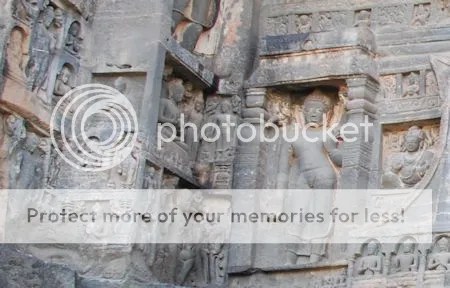
Hier is hij dan. Het enorme beeld van de overleden Boeddha. Als een prins die ligt te slapen. Er is een speciale naam voor deze voorstelling: Mahaparinitvana.

De gids die ik in Ajanta kocht zegt over dit beeld het volgende:

The usual cliche of figures of Buddha on the walls of the aisles is however, relieved by two scenes, one representing the mahaparinirvana of Buddha and the other, the Assault and Temptation of Mara.
The former, carved on the left wall near the side-door, contains a colossal figure of Buddha reclining on his right side on a couch between two sala trees; below are the figures of his disciples and followers mourning his decease, and above are celestial beings.


 photo DSC_0757Cave26ChaityaGriha.jpg

Zicht op het interieur van cave 26.


 photo DSC_0760ZijkantVanDeStupa.jpg

De stupa is heel uitgebreid gedecoreerd zoals hier te zien aan de zijkant.


 photo DSC_0760ZijkantVanDeStupaDetail.jpg

Detail.


 photo DSC_0761ZeerRijkeDecoratie.jpg


 photo DSC_0762TemptationOfMara.jpg

Dit is de tweede belangrijke beeldengroep in deze Chaitya-Griha: Assault and Temptation of Mara. Op het web heb ik maar een redelijke foto van deze beeldengroep kunnen vinden en die toont Mara niet eens. Die zit namelijk (onder andere) op een olifant, links boven de Boeddha.

De gids schrijft hierover:

The second scene also occurs on the same wall. Here Buddha is seated, with his right palm in the bhumisparsas mudra under the Bodhi tree at the centre; on the left is Mara on an elephant accompanied by his host of demon-forces attacking Buddha; on the right is the retreat of Mara; in the foreground are the daughters of Mara trying to tempt Buddha by dance and music; and in the bottom right corner is the figure of the dejected Mara.


 photo DSC_0765InterieurChaityaGriha01.jpg

Nogmaals het interieur.


 photo DSC_0765InterieurChaityaGriha02DeStupaHeelRijkGedecoreerd.jpg

De volgorde van de foto’s is een beetje verwarrend maar dat is veroorzaakt doordat ik slecht voorbereid was op deze grot die drie ingangen bleek te hebben en de drukte in deze zeer tot de verbeelding sprekende Chaitya-Griha. In de oude grotten is de stupa niet of nauwelijks gedecoreerd. Deze veel jongere grot laat de ontwikkeling in het Boeddhisme en en de kunst goed zien.


 photo DSC_0769.jpg


 photo DSC_0770DeLaatsteBlik.jpg

Een laatste blik op de site.


 photo DSC_0771CadeauBoekOverAjantaEnEenOverElloraKeurigIngepakt.jpg

Ik kocht er twee gidsen. Een gids over Ellora en een over Ajanta. Ze werden keurig ingepakt. Thuis heb ik ze uitgepakt en dan zien ze er als volgt uit:

 photo DSC_0771CadeauBoekOverAjantaEnEenOverElloraKeurigIngepaktEnDanThuis.jpg


 photo DSC_0772EenVanDeVeleVogelsOpDeSite.jpg

In de afdaling naar de uitgang had ik nog even tijd om een van de vele vogels die er leven te fotograferen.


 photo DSC_0773AjantaCaves.jpg

Ajanta Caves

Ajanta Caves are famous for their murals which are the finest surviving examples of Indian Art, particularly painting. These caves were excavated in horse-shoe shaped bend of rock scarp nearly 76 mtr in height overlooking a narrow stream known as Waghora.
The location of this valley provided a calm and serene environment for the Buddhist monks who retreated at these secluded places during the rainy season. Each case was connected to the stream by a flight of steps, which are now almost obliterated, albeit traces of some could be noticed at some places. In all 30 caves were hewn out of the living rock in different periods according to the necessity.
Out of these, five (cave 9, 10, 19, 26 and 29) are Chaityagrihas and the rest are vihares. In date and style also these caves can be divided into two broad groups. Out of the 30 caves 6 caves belong to the earliest phase of Buddhism ie Hinayana. Caves 9 & 10 which are Chaityagrihas and 8, 12, 13 and 15A which are Viharas belong to this phase. These caves are datable to the pre-Christian era, the earliest among them being cave 10 dating from the second century BC where the object of worship is a stupa. These caves are imitation of contemporary wooden constructions even to the extent of fixing of wooden rafters and beams to the ceiling even though they are non-functional.
These early caves were painted but nothing substantial has survived. Caves No 9 and 10 clearly show some vestiges of painting. The headgear, ornaments of the images in these paintings resemble the bas-relief sculpture of Sanchi and Bharhut.
The addition of new caves could be noticed again during the period of Vakatakas, the contemporaries of the imperial Guptas. These were caused to be excavated by the royal family and also the feudatories owing allegiance to the Vakatakas. Varahadeva, the minister of Vakataka king Harishena (475-500 AD) dedicated Cave 16 to the Buddhist Sangha while cave 17 was the gift of a prince (who subjugated Asmaka) a feudatory of the same king. A flurry of activity at Ajanta was between mid 5th century AD to mid 6th century AD. Hieun Tsang, the famous Chinese traveller who visited India during the first half of the 7th century AD has left a vivid and graphic description of the flourishing Buddhist establishments here even though he did not visit the caves.
A solitary Tashtrakuta inscription in cave no 26 indicates its use during 8th – 9th centuries AD. The second phase departs from the earlier one with the introduction of new pattern in layout as well a the centrality Buddha image, both in sculpture as well as in paintings.
All these caves which were once painted but now the best examples of these exemplary paintings of Vakataka period could be noticed only in caves 1, 2, 16 and 17. The variation in style and execution in these paintings also are noticed, mainly due to different authors who followed contemporary style.
the main theme of the paintings is the depiction of various Jataka stories-different incidents associated with the life of Buddha, and the contemporary events and social life. The ceiling decoration invariably consists of decorative patterns, geometrical as well as floral. Apart from painted representations, sculptural panels also adorn the beauty of the caves.
Ajanta paintings are the best examples of Tempra technique, executed after elaborate preparation of rock surface. After chiselling rock surface, different layers of clay mixed ferruginous earth, sand, fibrous material of organic origin were applied very carefully. Then the surface was finally finished with a thin coat of lime wash.
Over this surface, outlines are drawn boldly, then the spaces are filled with requisite colours in different shades and tones to achieve the three dimensional effect of rounded and plastic volumes. The colours and shades utilised also vary from red and yellow ochre, terra verte, to lime, kaolin, gypsum, lamp black and lapis lazuli. The chief binding material used here was glue.
The group of caves is inscribed by the UNESCO as a World Heritage Monument in the year 1983.


Het lettertype in de titel van 20 december 2012 is van Göran Söderström/Goran Soderstrom en heet Shabash Pro Light.