De vorige keer noemde ik al de grote gotische werken waarvan
er een aantal te zien zijn in de Galleria dell’Accademia.
Stukken die je vaker in kerken ziet.
Op de tentoonstelling wordt ook aandacht besteed aan de opbouw en
constructie van deze werken.
Je heb te maken met het centrale paneel, zijluiken (al dan niet
bewegend), en een opbouw met torenspitsen. Soms driedimensionaal.
In die opbouw zitten dan weer kleinere voorstellingen (cusps) en dat is
ook zo met de onderkant (predella).
Complex om te zien, theologisch complex.
De afbeeldingen zijn niet de beste foto’s die ik ooit gemaakt heb.
De werken zijn zo groot en wat voor een mens een goede belichting is,
is voor een camera niet altijd goed.
Maar deze keer gaat het mij vooral om de vorm, hoe de werken in
elkaar zitten.
Een algemene tip: let op het wiel.

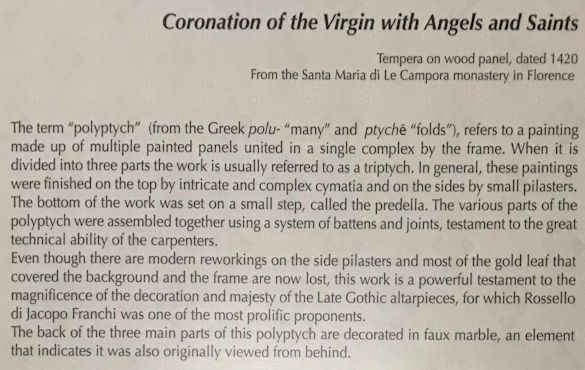
Gelukkig had ik een gids gekocht van de Galleria dell’Accademia, want ik had hulp nodig bij mijn foto’s. Florence, Galleria dell’Accademia, Rossello di Jacopo Franchi, Coronation of the Virgin with angels and saints, 1420.


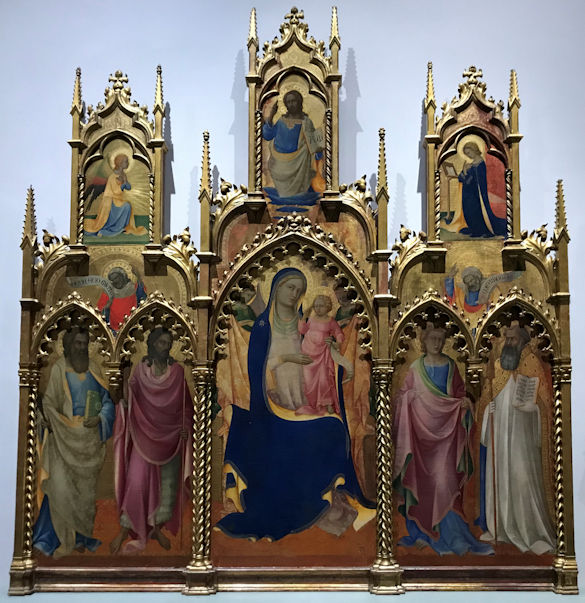
Mariotto di Nardo, Enthroned Madonna and Child with angels and saints, circa 1391, tempera on wood panel.

Piero di Giovanni detto Lorenzo Monaco, Enthroned Madonna and Child with angels and saints, 1410, tempera on wood.

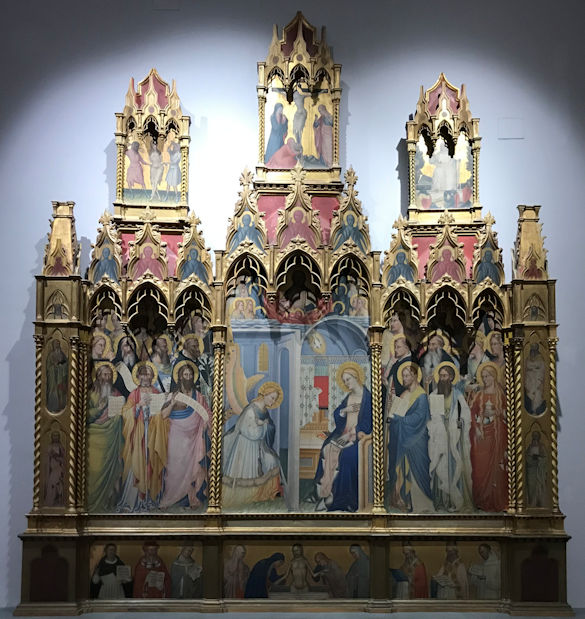
Giovanni del Biondo, Annunciation, 1380 – 1385.
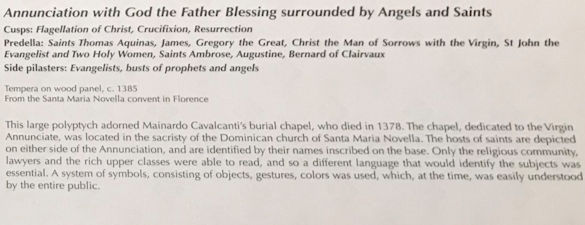

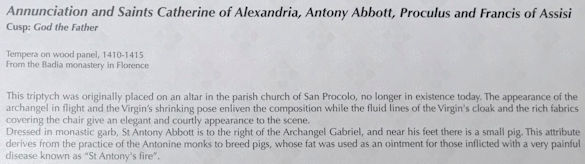
Piero di Giovanni detto Lorenzo Monaco, Annunciation and Saint Catharine of Alexandia, Anthony Abbott, Proculus and Francis of Assisi, 1410 – 1415, tempera on wood panel.

Dan is dit, helemaal links op het werk, Saint Catharine of Alexandia.

Dit is de prachtige, zwevende engel van de Aankondiging.

Maestro della Madonna Straus, Saint Catherine of Alexandria, Saint Francis, 1400 – 1410, tempera on wood.
Over de noodnaam ‘Maestro della Madonna Straus’ vertelt Wikipedia,
(ga er even voor zitten 🙂 ):
Master of the Straus Madonna (active c. 1385 – 1415), was an Italian painter.
He was active in Florence and is named after a depiction of a Madonna and Child donated by the Straus family to the Museum of Fine Arts, Houston. He is possibly the same person as Cenni di Francesco di Ser Cenni. One of the most individual and lyrical Late Gothic Tuscan painters, he bridges the gap between Agnolo Gaddi and Lorenzo Monaco. His slender, pale figures blend spiritual evanescence with Giottesque solidity of form and are at their most expressive in the Man of Sorrows with Instruments of the Passion of c. 1395 and the Annunciation of c. 1405 (both Florence, Accademia), in which a highly refined sense of design balances perfectly with a poetic and vivid sense of colour. Striking touches of realism, as seen in the cockerel of the Passion or Gabriel’s lilies, enliven these scenes. The subtly modelled Virgin and Child with Two Angels in the church at Sagginale (nr Borgo San Lorenzo), originally flanked by Sts John the Baptist and Dominic (both Oxford, Christ Church Picture Gallery), is one of the Master’s finest mature works. Like Starnina and influenced in part by Spinello Aretino and the Giottesque revival, his graceful yet quietly compelling figures were important for the generation of Masolino in the last years of the Late Gothic style.
Het wiel heeft te maken met de afbeeldingen van de heiligen.
Catharina van Alexandië wordt heel vaak afgebeeld met een wiel.
Op de laatste foto staat ze op een wiel en op de detailfoto
van Lorenzo Monaco, Annunciation and Saint Catharine of Alexandia,
Anthony Abbott, Proculus and Francis of Assisi;
staat het wiel schuin links achter haar, op de grond.
Dat wiel is vaak kapot:
“Toen zij als straf voor haar geloofsijver tot de doodstraf werd veroordeeld, werd het folterwerktuig, een draaiend rad, door de bliksem getroffen “








 Argusvlinder