Paseo de los Museos

In een van de ruïnes van de grotere kloostercomplexen in Antigua
is nu een 5-sterren hotel gevestigd met een serie van musea.
Het overtrof mijn verwachtingen.
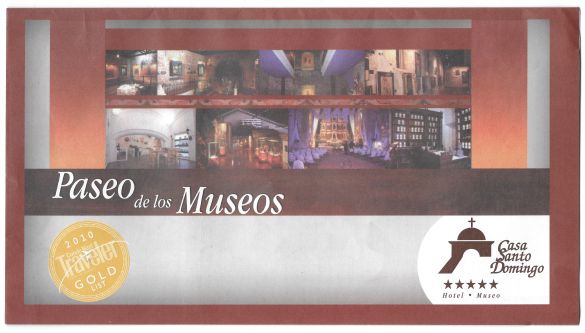
Scan027CasaSantoDomingoPaseoDeLosMuseosAntiguaGuatemala

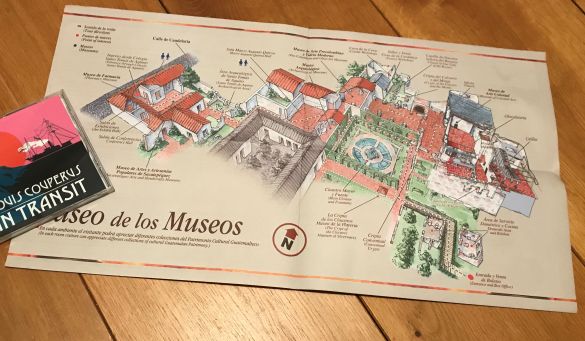
Als bezoeker krijg je deze luxe plattegrond. Om je een idee te geven heb ik dit document op de foto gezet met een hoesje van een CD.

IMG_2617PlattegrondNaastCD

IMG_2618PlattegrondOpenGevouwen

Geopend ziet het er dan als hierboven uit.


Zelf beschrijft het museum zich als:

Museums Promenade
The Museums Promenade is a cultural route created by an agreement between the San Carlos de Guatemala University and the Casa Santo Domingo Hotel.
It is a route that makes it possible to visit the museums installed in what was the church and convent of Santo Domingo and the Santo Tomás de Aquino College.
During the time of the Spanish domination these places constituted one single unit.


Zo tref je daar The Colonial Museum, The Archeology Museum, The Museums of Pre-Colombian Art and Modern Glass en ten minste nog 3 musea aan.


Besides the successful integration of the colonial architectural vestiges with audacious contemporary concepts in important areas of the convent, the visit to significant places has been made accessible.
These places include the burial and vigil crypts among which the Calvary Crypt is outstanding because it has an extraordinary scene of the crucifixion made in polychrome stucco and dated 1683.

Het eerste museum die we bezochten was ‘The Museum of Silverware’.
De musea zijn niet heel erg groot, maar samen is het een prachtige
collectie met fascinerende werken.
De folder bevat wat opgeklopte marketing-taal maar als ik het niet
de moeite waard had gevonden zou ik er niet zo uitgebreid bij stil staan.
DSC00715 AntiguaCasaSantoDomingoPaseoDeLosMuseosProcessionFlagsSilver01

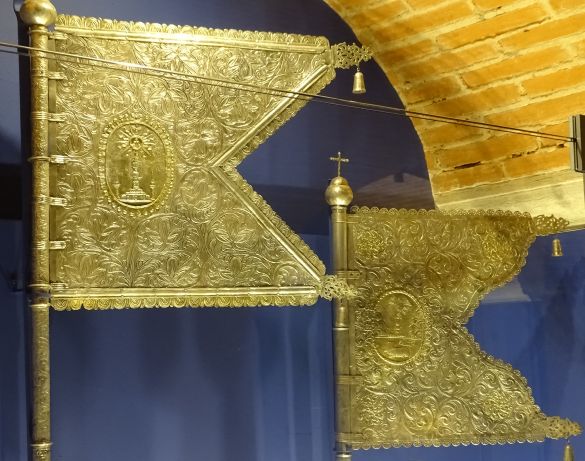
Zilveren processievlaggen. Als er iets op de musea is af te dingen is dat de informatie over de stukken beperkt is. Geen jaartal, geen vindplaats. Dat is erg jammer. Dat kun je nog accepteren als er bijvoorbeeld een catalogus verkrijgbaar is waar die informatie in is opgenomen, maar die heb ik het winkeltje niet gevonden.


DSC00715 AntiguaCasaSantoDomingoPaseoDeLosMuseosProcessionFlagsSilver02

Afbeelding van een monstrans op de vlag.


DSC00715 AntiguaCasaSantoDomingoPaseoDeLosMuseosProcessionFlagsSilver03

Met een bel op het uiteinde van de vlag.

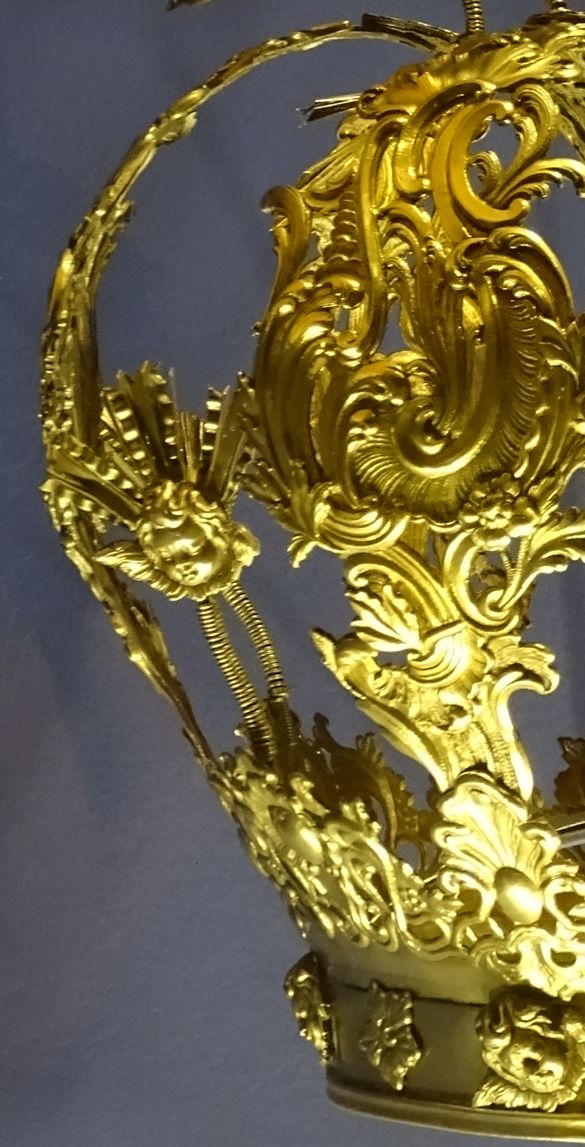
DSC00716 AntiguaCasaSantoDomingoPaseoDeLosMuseosCrown01

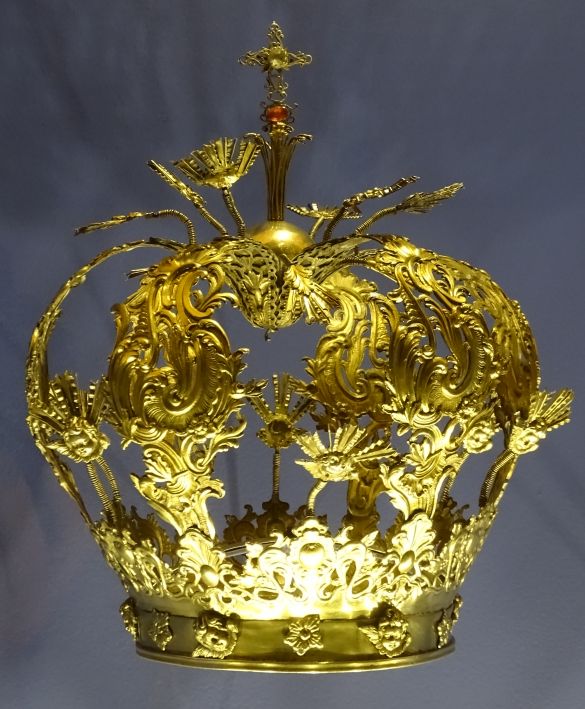
Een kroon. Bedoeld voor op een houten beeld, bijvoorbeeld.


Crowns
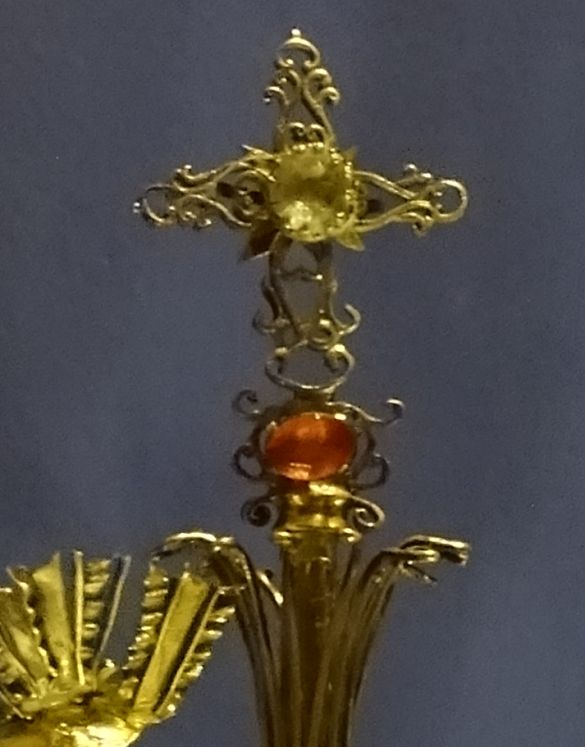
Some crowns are ornamented with precious stones, and gird the head of the saints as a symbol of royal dignity or nobility.
When they present two or three arcs they are called Imperial Crowns.
They may also have “shakers” as an ornament and symbol of divinity.


Wat hier bedoeld wordt met “shaker” is me niet helemaal duidelijk. Ik vermoed dat hier ‘scepter’ bedoeld wordt. Maar ben niet zeker.


Crowns also usually have a band-shaped piece that goes from side to side at the vase of the hoop, pierced in the centre to fit the image and be secured with a screw.
In general, silver crowns were gilded.
DSC00716 AntiguaCasaSantoDomingoPaseoDeLosMuseosCrown02

Met decoratie van (edel)stenen.


DSC00716 AntiguaCasaSantoDomingoPaseoDeLosMuseosCrown03


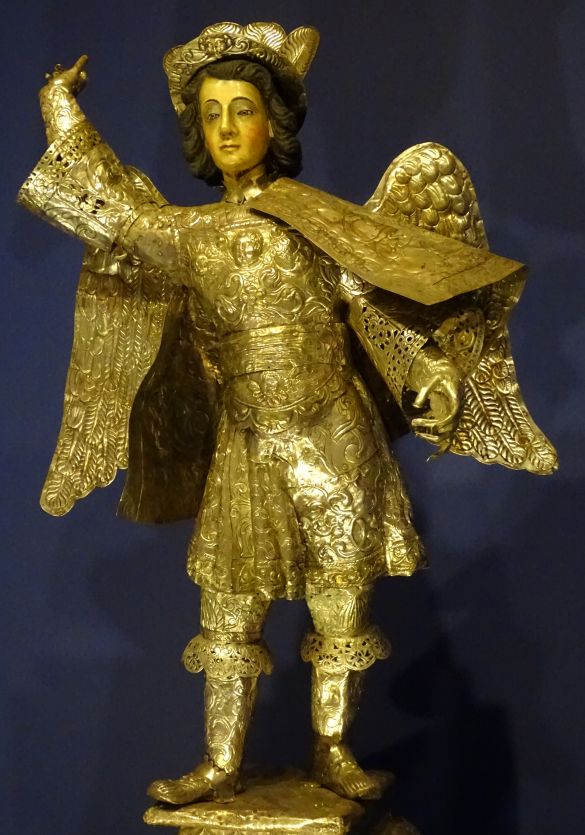
DSC00718 AntiguaCasaSantoDomingoPaseoDeLosMuseosSaintMichaelTheArchangel01

De aartsengel Michael. Saint Michael the Archangel.


St. Michael is one of the principal angels; his name was the war-cry of the good angels in the battle fought in heaven against the enemy and his followers.
Christian tradition gives to St. Michael four offices: to fight against Satan, to rescue the souls of the faithful from the power of the enemy, especially at the hour of death, to be the champion of God’s people and to bring men’s souls to judgement.


An attribute of this archangel is the Sun and the Moon on his chest or breastplate.
They symbolize that human nature pales before the power of God.

DSC00718 AntiguaCasaSantoDomingoPaseoDeLosMuseosSaintMichaelTheArchangel02SunAndMoon

Met op de borst voor de kijker links de Zon en rechts de Maan.
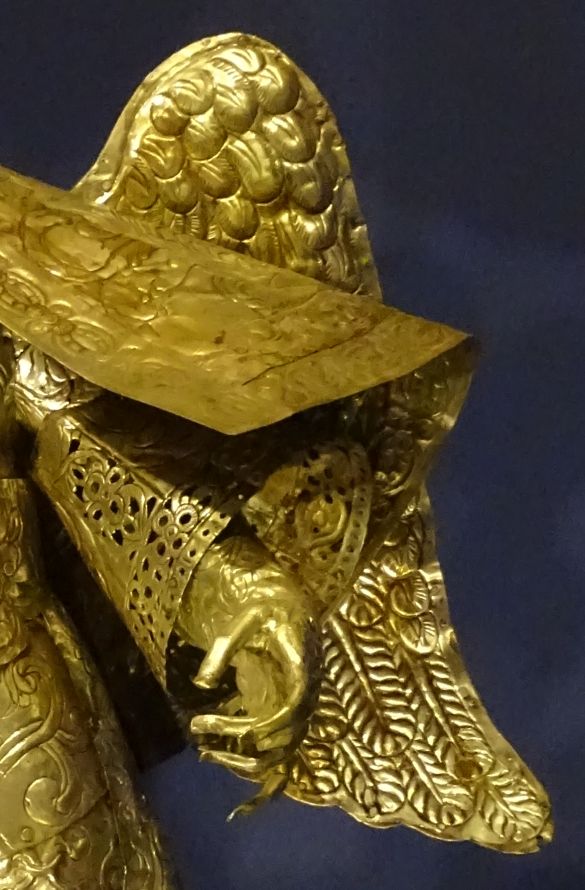

DSC00718 AntiguaCasaSantoDomingoPaseoDeLosMuseosSaintMichaelTheArchangel03WingAndArm

Detail van de vleugel en arm van de aartsengel.
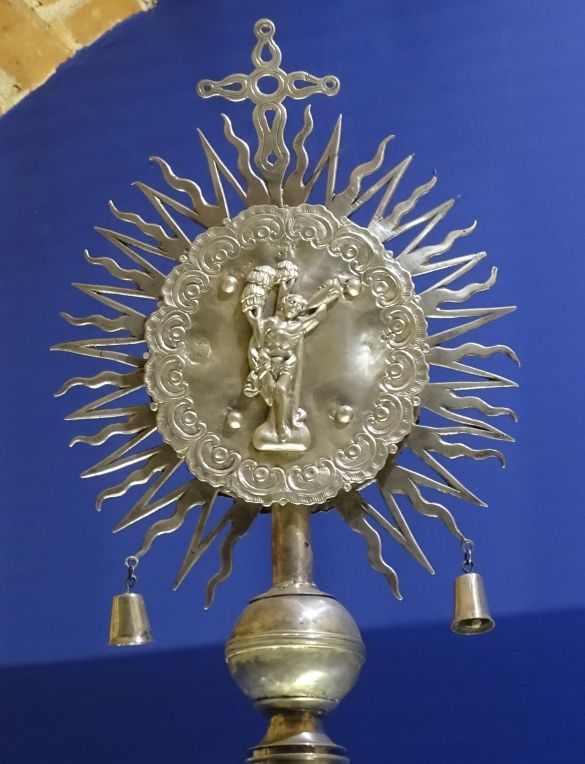

DSC00720 AntiguaCasaSantoDomingoPaseoDeLosMuseosProcessionalCross

Processiekruis. Zo’n voorwerp was eerder te zien, in gebruik, op de foto’s van ons verblijf in Chichicastenango.


Processional Monstrances and Processional Cross

The Catholic Christian Brotherhoods had their own shields which show their Patron Saint and its own symbols.
They have different shapes: round, oval-shaped sun with rays, etc.
In any case, they bear on one side the symbol that represents the group.


The shield is encased in a silver or wooden rod and is used during the processions organized by the brotherhood or “cofradia”.


The processional cross, is also placed at the end of a rod or pole.
It is carried as well during processions.

DSC00722AntiguaCasaSantoDomingoPaseoDeLosMuseosSilverAltarpiece01

Zilveren altaarstuk: ‘Altarpiece made from wood and plaques of embossed, carved and engraved silver.’


DSC00722AntiguaCasaSantaDomingoPaseoDeLosMuseosSilverAltarpiece02

Detail.


Museo Arqueologico Rossbach

Volgens de web site van The Lonely Planet bevat dit museum onder
andere de collectie van een Duitse priester die in Chichicastenango werkte:

Chichi’s archaeology museum holds the collection of Hugo Rossbach, a German who served as the town’s Catholic priest until his death in 1944. It includes some beautiful jade necklaces and figurines, along with ceremonial masks, obsidian spearheads, incense burners, figurines and metates (grindstones for maize). A second hall features a portrait gallery of cofradía leaders.

DSC00407ChichicastenangoMuseoArqueologicoRossbach

Dit boek beschrijft op deze pagina’s links in een taal die ik niet herken en rechts in het Spaans het bekendste manuscript: Popol Buj of Popol Vuh. ‘Vuh’ = boek, het boek van de raad.


Wikipedia:

De Popol Vuh (K’iche’: Popol Wu’uj) is een historisch-mythologische tekst van de K’iche’ (in de oude spelling: Quiché), een Mayavolk uit Guatemala, die kort na de Spaanse verovering voor het eerst in Europees schrift werd uitgeschreven (midden 16e eeuw). Het document werd vermoedelijk opgesteld door leden van de K’iche’-adel om in de beginnende koloniale maatschappij de eigen positie te legitimeren.

Ik ga graag in Nederland naar musea en in het buitenland
is dat niet anders. Groot of klein, dat maakt niet uit.
In de drukte van Santo Tomas en de zondagmarkt, is het even rust
in dit bijzondere museum.
De omstandigheden, verlichting en de oude vitrines zijn misschien
niet ideaal maar dat wordt goedgemaakt door de sfeer, de voorwerpen
en de toewijding van de mensen die het museum draaiend houden.

DSC00408ChichicastenangoMuseoArqueologicoRossbach

Niet overal staan verklarende teksten bij. Misschien heb ik die over het hoofd gezien en waren ze er wel.


DSC00409ChichicastenangoMuseoArqueologicoRossbachNicoyaPolycromo(Polychroom)SuresteDeMesoamericaPreclasicoTemprano(VroegPreklassiek)

Op het laartje staat: Nicoya Polycromo (polychroom of meerkleurig) Sureste de Mesoamerica Preclásico Temprano (Vroeg pre-klassiek).


DSC00410GuatemalaChichicastenangoMuseoArqueologicoRossbachChama(vlam)ClasicoTardio(laatklassiek)TierrasBajas(laagland)

Bij dit voorwerp stond een kaartje met de volgende tekst: Chama (vlam) Clasico Tardio (laat-klassiek), Tierras Bajas (laagland).


DSC00411ChichicastenangoUitzichtVanuitMuseoArqueologicoRossbach

Ergens in Museo Arqueologico Rossbach kon je naar buiten kijken en had je dit uitzicht.


DSC00412GuatemalaChichicastenangoMuseoArqueologicoRossbach

In meerdere talen hing waarschijnlijk dezelfde tekst. Dit is natuurlijk de Engelse versie. Het vertelt eigenlijk meerdere verhalen: de geschiedenis van de stad, de bevolking die hier woont en verhaalt van de verschillende gewoontes. Het beschrijft ook het belangrijkste feest in het jaar: Santo Tomas.


Chichicastenango

The name means, “place of nettles” and was founded by Quichés who fled from the destruction of Utatlán.
They settled close to Chaviar, commercial emporium of the Cakchiquels.
Today the quiché indians continue calling the town “Siguan Tinamit” which means “Place surrounded by ravines” and they called themselves “Mashenos” derived from Max which at the same time means Tomas.
Chichi, as it is popularly called, is located 145 kilometers from Guatemala City.


From early age the women learn the art of weaving an a waistheld loom.
The “huipiles” carry symbols that represent the universe as well as lightning, corn, cardinal points, the sun and a beveled bird.

The men weave their belts and wool jackets for their black suits.
The jacket and pants are very similar to those used by Spanish soldiers during the colony.


The wooden masks that dancers use and which symbolically bring them closer to their gods are manufactured in Chichicastenango.
A mask factory and a were house (warehouse?) that keeps the costumes for the dancers and rents them the outfits, is located in the last house on the trail to Pascual Abaj.


There are fourteen ‘cofradias’ (brotherhoods) in Chichicastenango, each with six or eight brothers of different rank and responsibilities.
Each “cofradia” is in charge of guarding a saint, which is keep (kept) in the house of the first mayor.
The saint is only taken out for processions and selected festivals.


The festive days of the Christian calendar are splendidly celebrated with fireworks, music and much color, and start the town’s most important fiesta, which takes place the 17th to 21st of December in honor (of) Santo Tomas.
Processions and traditional dances like La Conquista and El Torito take place.
This is one of the three towns where the daring acrobatic act “El Palo Volador”, of the pre-hispanic origin takes place, in honor of the sun.

Korte samenvatting:
De naam Chichicastenango komt van ‘plaats met brandnetels’.
De oorspronkelijke bewoners zijn de Quichés.
De vrouwen leren op jonge leeftijd te weven.
De ‘huipiles’ zijn de blouses met typische geweven voorstellingen.
Mannen maken hun zwarte pakken van wol.
De houten maskers worden gebruikt bij de dansen.
Er zijn 14 ‘cofradias’ of broederschappen of buurtschappen
in Chichicastenango en ze zijn religieuze organisaties.
Christelijke feestdagen worden met vuurwerk, processies en
traditionele dansen gevierd.
Een speciale plaats neemt ‘El Palo Volador’ in, jonge mannen
die acrobatische toeren uithalen in een hoge paal,
boven het publiek.

Wikipedia heeft een pagina over de Quiché:

De K’iche’ of Quiché zijn een Mayavolk woonachtig in Guatemala. Met ongeveer 2.300.000 zijn zij het talrijkste van de Mayavolkeren.

De K’iche’ leven in het middenwesten van Guatemala, voornamelijk in het naar hen genoemde departement El Quiché, en in de departementen Quetzaltenango, Sololá en Totonicapan. Het gebied waar de K’iche’ leven is overwegend bergachtig. Ook leven er emigrantengemeenschappen in Mexico en de Verenigde Staten.

Het woord K’iche’ betekent ‘veel bomen’ in het K’iche’, en is de benaming die zij aan hun leefgebied gaven. Van de vertaling in het Nahuatl, Cuauhtemallan, is de naam Guatemala afkomstig.

Terwijl de Maya’s van Yucatán en El Petén op hun hoogtepunt waren tijdens de klassieke periode, viel het hoogtepunt van de precolumbiaanse K’iche’ in de postklassieke periode. Het K’iche’-koninkrijk Q’umarkaj werd in het begin van de 12e eeuw gesticht, wist een groot deel van de Guatemalteekse hooglanden onder controle te krijgen, en veranderde in een welvarend handelsrijk. De 15de-eeuwse K’iche’ zijn vooral bekend uit de Popol Vuh (K’iche’: Popol Wu’uj), een inheems geschiedenisboek dat kort na de Spaanse verovering is opgesteld.

Aan het eind van de 15e eeuw werden de K’iche’ tot vazallen van de Azteken. De Spanjaarden, geleid door Pedro de Alvarado, vielen in 1523 Guatemala binnen, gesteund door de Kaqchikel, de traditionele vijanden van de K’iche’. In februari 1524 werd de laatste K’iche’-heerser, Tecún Umán, gedood door Alvarado.

In de jaren 1980 hoorden de K’iche’ tot de grootste slachtoffers van de Guatemalteekse genocide.

De mensenrechtenactiviste Rigoberta Menchú, winnares Nobelprijs voor de Vrede in 1992, is een K’iche’.

DSC00413guatemalaChicgicasrtengoMuseoArqueologicoRossbach

Deze foto geeft een beeld van het museum.


DSC00414GuatemalaChichicastenangoMuseoArqueologicoRossbachModelVanElPaloVolador

In een achterzaaltje, tegen de muur, stond een schaalmodel van de hoge paal met het ‘platform’ die gebruikt wordt bij ‘El Palo Volado’.


Altijd leuk, zo’n museum.