Een hele lijst vandaag met 19 werken.Sommige wel heel, heel bijzonder.
 Alex Katz.
 Allereeste optreden van Batman in een comic, mei 1939.Misschien een beetje vreemde eend (vogel, zoogdier) in de bijt.De kaft van het eerste comic boekje waarin Batman optreedt.
 Cornelis Dusart, Roker kijkend in een kruik.
 Daniel Buren.Het gebeurt niet vaak dat ik werken opneem met alleen de naamvan de kunstenaar. Vandaag twee maal.Daniel Buren uit Belgie is de maker van dit werk bij De Haan.
 Edvard Munch, Winter night, 1923, oil on canvas.Dit beeld past precies bij het beeld wat ik zie als ik nu naar buiten kijk.
 Four lidded ritual wine ewers (guang), early Anyang period to early Western Zhou period, 13th – early 10th century BCE, bronze.Vier rituele wijnbekers met deksel.Afkomstig uit China.
 Gebedsnoot, zilver en buxushout, circa 1510 – 1520 (4.8 cm in diameter).Dit fantastische voorwerp is onlangs gekocht door het Rijksmuseum.Ik wist dat er zo iets als gebedsnoten bestonden.Maar ze zijn erg zeldzaam.
 Imperial cloisonne, enamel, double crane cencers, Yongzheng period, 1723 – 1735.Nog een groep voorwerpen uit China.En wat voor een stel!
|
HIGHLY IMPORTANT AND EXCEEDINGLY RARE PAIR OF IMPERIAL CLOISONNE ENAMEL DOUBLE CRANE CENSERSYONGZHENG PERIOD (1723-1735)Each group superbly modeled as a pair of large and smaller cranes standing on an elaborate champlevxc3xa9 and cloisonnxc3xa9 enamel rockwork-form base encircled by crested waves, standing on tall legs naturalistically detailed with cylindrical bands, the smaller crane with one leg slightly bent, their long necks gracefully curved as the smaller crane looks backward towards the taller crane which grasps a double-peach sprig in its long pointed beak, the bodies and feathers intricately and realistically rendered primarily in black and white enamels within gilt outline, the red crests and blue beaks, their wings forming a cover for the hollow body57 in. (145 cm.) highHARMONY, LONGEVITY AND FILIAL RESPECTROSEMARY SCOTT – INTERNATIONAL ACADEMIC DIRECTOR, ASIAN ARTThese magnificent cranes are a spectacular reflection of the auspicious beliefs attached to red capped cranes by the Chinese court. The Chinese word for crane is he, which is a homophone for the word for harmony, and thus cranes represent peace. Their long legs were described as resonating with the harmonies of nature and Heaven. Cranes are also known to live for many years and thus have become associated with long life, and indeed are often depicted as the familiars of the Star God of Longevity, Shoulao. As early as the 12th century, the Chinese Emperor Huizong (r. 1101-25) painted a flock of cranes, which were seen flying above the palace in AD 1112, in order to record such an auspicious event. In the 18th century court artists were frequently required to paint cranes by their imperial patrons.A hanging scroll by an anonymous court artist, Empress Xu Serves Food, dating to the early Qianlong reign (1736-95), used to be hung in the Palace of Concentrated Purity during the New Year Festival. It was accompanied by a poem by the Qianlong Emperor, commending the Han dynasty Empress Xu for her filial conduct in personally served food to the Emperor’s mother and exhorting his empress and concubines to follow her example. In the foreground of the painting large red capped cranes are shown wandering about the steps of the palace, as wishes for longevity and also representing the harmony achieved by such filial behaviour. Indeed many 18th century informal court portraits include cranes somewhere in the landscape.Many court paintings, however, focus solely on the depiction of cranes. Among those paintings preserved in the Palace Museum, Beijing, are Shen Quan’s (1682-1760) hanging scroll, Pine, Plum and Cranes, dated by inscription to AD 1759. While, reminiscent of Huizong’s 12th century work, Yu Xing’s (1692-after 1767) hanging scroll, Cranes against Sky and Waters, c.1747, bears an inscription by the Qianlong Emperor and twelve Qianlong seals. Even the famous Jesuit artist Giuseppe Castiglione (1688-1766), known in China as Lang Shining, who served the Kangxi, Yongzheng and Qianlong Emperors, painted a number of representations of cranes. Among these are the hanging scroll, Cranes and Flowers, which included two crane chicks, as well as the impressive Pines and Cranes. Castiglione often painted the cranes with flexed necks in a way copied by other court artists, and seen in the famous trompe l’oeil painting on the north wall of the theatre hall in the western part of Emperor Qianlong’s Juanqinzhai (Studio of Exhaustion from Diligent Service or Lodge of Retirement) in the Ningshougong (Palace of Tranquillity and Longevity). Interestingly, while the majority of extant crane censers have necks rising in a simple curve, the necks on some of the cranes in the current group from Fonthill are more complex in their stance, perhaps reflecting the influence of paintings of this type.This pair of double crane censers is not only unusually large, and particularly detailed, but also appears to be unique in having two cranes in each group, rather than being a pair of single cranes. All the extant cloisonnxc3xa9 crane censers and candle holders published from the palace collections have only a single crane on each base. The current crane censers are comprised of a large crane with two peaches in its beak, and a smaller crane reverently looking up at it. The base is finely wrought in the form of rocks rising from the sea, and then each crane stands on a further rock – the taller crane’s rock being higher than that of the smaller crane. There is something in the composition of these crane groups that calls to mind the famous painting by Giuseppe Castiglione (Lang Shining) of the Yongzheng Emperor (1723-35) with Prince Hongli (the future Qianlong Emperor, r. 1736-95) known as Spring’s Peaceful Message. Here the young Prince is shown smaller than the Emperor, bowing slightly, and looking respectfully up at his father as the two men exchange a spray of prunus, while behind and to the side there are bamboo stems. In his later years the Qianlong Emperor’s admiration for this painting led him to identified himself as the younger man in an inscription which he wrote on the painting in 1782, when he was 71 years old, and to commission a trompe l’oeil painting of the same subject for one of his favourite private rooms, the Sanxitang (Study of the Thre |
 Julian Opie, On average present day humans are 1 inche shorter than 8000 years BC, 1991.
 Giuseppe Vermiglio, Cristo davanti Pilato, oil on canvas, 1576 – 1622.Bij deze afbeelding werd Giuseppe Vermiglio vermeldals maker maar ook Leonello Spada.Na wat onderzoek lijkt Giuseppe Vermiglio toch correct.Overigens zijn beide volgelingen van Carravagio. En dat is te zien.
 Malinaltepec Mask, Teotihuacan-style funerary object, circa 200 BC.
 Mitsy Groenendijk, John, 2010.
 Ornament, Human face, Longshan culture, 3000 – 200 voor Christus, jade (nephrite).
 Roger Fenton, Pasha and Bayadxc3xa8re, 1858, foto.Op de foto is Roger Fenton zelf Pasha.Foto is gemaakt in een studio in London.
 Sophie Taeuber-Arp, Mouvement de lignes en couleurs, 1940.
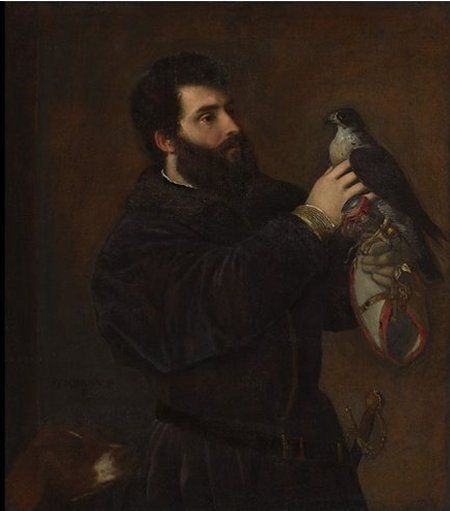 Tiziano Vecellio (Titiaan), Georgio Cornaro with a falcon, 1537, oil on canvas.
 William Caxton, The Caxton Missal, 15th century, printed by Englandxe2x80x99s first printer.Deze missaal is een drukwerk van de eerste drukker van Engeland: William Caxton.
 William Caxton, The Caxton Missal, detail.
 Wu Guanzhong, Livestock, 1957, oil on board.
 Argusvlinder